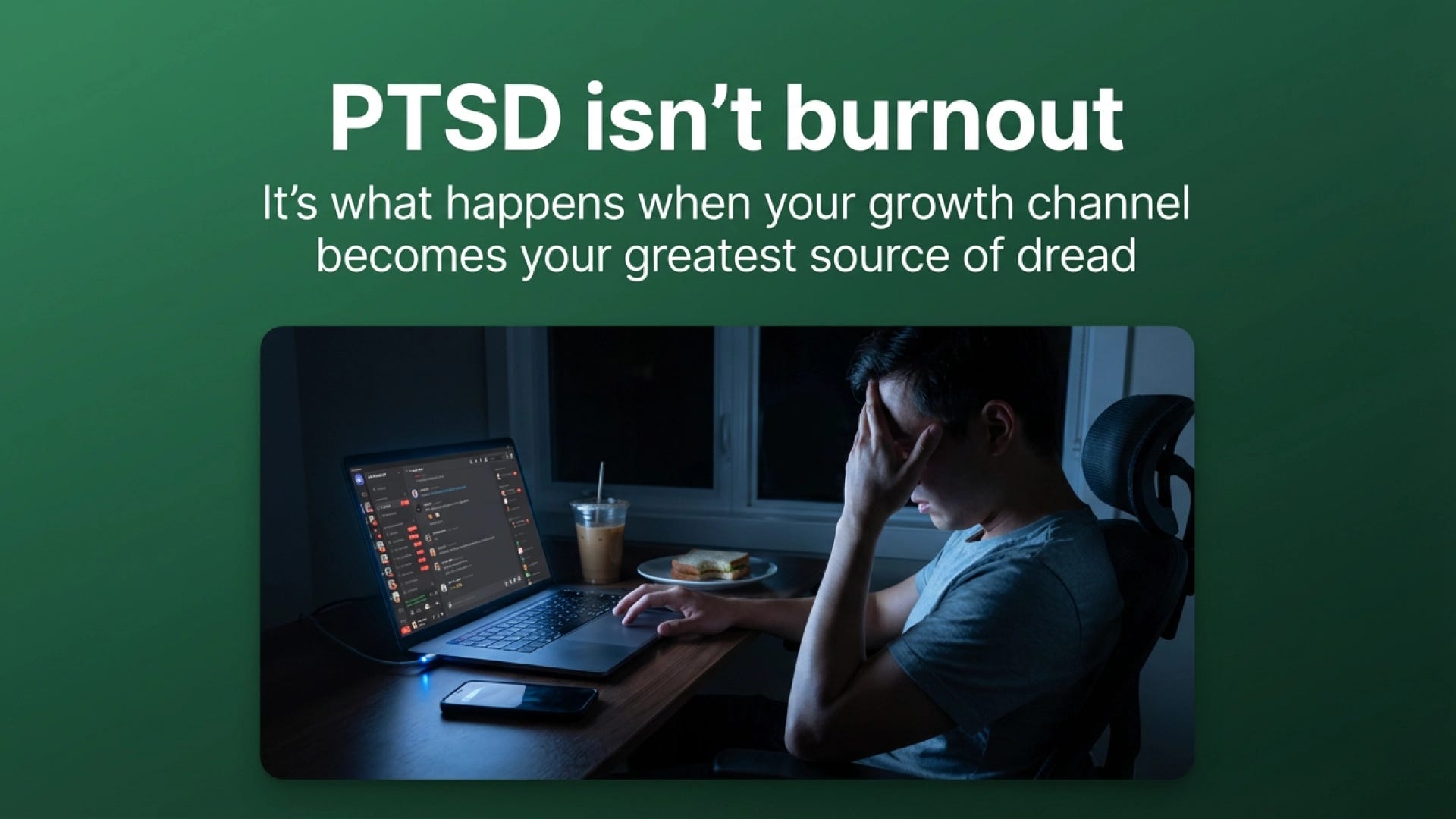
A founder told me last month that he gets a physical reaction when he sees the Discord notification badge. His chest tightens. His breathing changes. He's conditioned himself to associate the app with stress.
This isn't uncommon.
I've talked to dozens of tech and eCommerce founders who used the word PTSD when describing their relationship with Discord. Not burnout. Not frustration. Actual trauma responses to a communication platform.
They stopped opening the app for days at a time. They lost sleep over community drama they felt powerless to prevent. They watched spaces they built with genuine care turn hostile because moderation systems collapsed under scale. They hired community managers who made ambitious promises during interviews and then created bigger problems than they solved.
The resentment becomes real. It burrows in.
You start associating Discord with failure. The notification sound triggers anxiety. Opening the app feels like checking a wound that refuses to heal. Eventually, you avoid it entirely, which makes everything worse because now your community is running without leadership.
Why This Happens
Most people treat Discord like it's Twitter with channels. They think community management means posting updates and responding to messages. They don't understand the platform psychology that makes Discord different from every other social space.
Discord isn't social media. It's infrastructure.
Running a Discord community properly requires understanding systems that scale without constant human oversight. It requires knowing when to automate and when automation destroys the human element people actually joined for. It requires moderation philosophy that prevents problems instead of just reacting to fires.
Most community managers don't have this knowledge. They've never worked with audiences at meaningful scale. They've never seen what breaks at one hundred members versus one thousand versus one hundred thousand. They apply tactics from other platforms and wonder why nothing works.
So founders end up micromanaging because nobody else can do it right. And micromanaging a Discord community is a path straight to the trauma responses I described above.
What Recovery Looks Like
I've spent years managing servers with over one point seven million members. I've maintained engagement rates at fifteen percent when industry standard is one to two percent. I've built systems for companies running eight figures in community-driven revenue across SaaS, AI, and eCommerce.
The work I do for clients like HeyGen and BlueWillow focuses on one specific outcome: transforming Discord from a source of founder anxiety into a strategic growth channel that runs without constant babysitting.
This means building actual infrastructure. Moderation systems that catch problems before they escalate. Onboarding sequences that turn new members into engaged participants within forty-eight hours. Automation that handles repetitive work while preserving the human touch that makes communities valuable.
It means finding the right balance between structure and flexibility. Too much control and your community feels corporate. Too little and it descends into chaos.
Most importantly, it means understanding that running a community properly is a full-time job requiring sophisticated systems and real expertise. Not something you hand to an intern. Not something you figure out on weekends between product work.
Your Discord Doesn't Have to Feel Like This
If you're carrying Discord trauma, that weight doesn't have to stay with you.
You shouldn't resent the platform that could become your best acquisition and retention tool. You shouldn't dread opening an app that could be driving sustainable revenue growth.
The problem isn't Discord. The problem is systems, psychology, and finding people who actually understand how communities work at scale.
Most founders don't realize their Discord problems are solvable. They think this is just what community management feels like. They accept the stress as unavoidable overhead.
It's not.
With proper systems and expertise, your Discord can run smoothly enough that you check it when you want to, not because you're afraid of what's happening in your absence. Your community can become a strategic asset instead of a liability that keeps you up at night.
That shift is possible. I've built it for companies managing millions in community revenue. The difference between Discord as trauma and Discord as infrastructure comes down to expertise and systems.
If this resonates, let's talk about fixing it.
You don't have to carry this weight. Your community can become the growth channel it was always supposed to be.
<<<<<<< HEAD