A founder reached out three months ago.
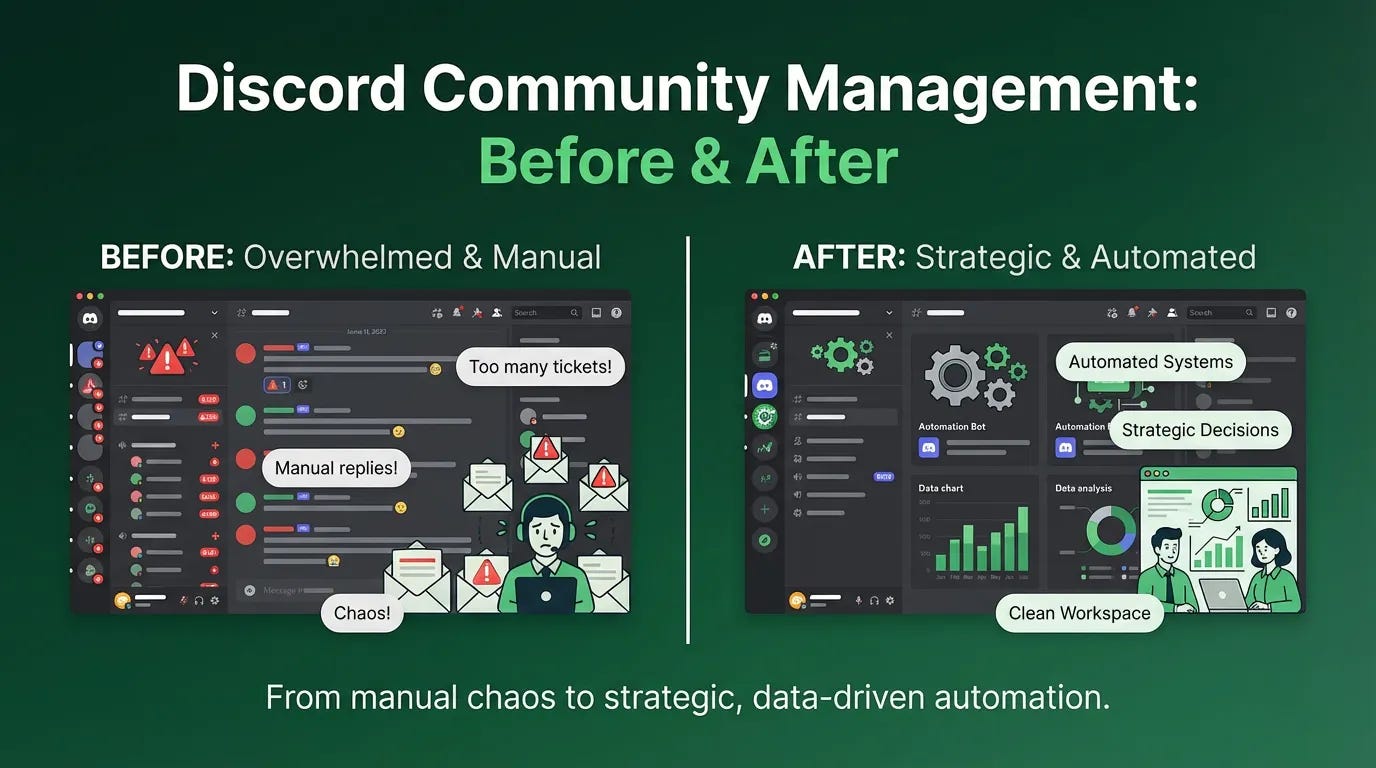
His Discord community was drowning. Member questions going unanswered for hours. Support team burned out. Engagement declining. He wanted to know if I could help him hire three more community managers.
I told him no.
Not because he didn't need help. Because more people would make his problem worse.
His community didn't have a staffing problem. It had a structural problem. And structural problems eat headcount for breakfast.
The Headcount Trap
Every executive facing community challenges eventually reaches the same conclusion: we need more support people.
The logic seems sound.
More questions than answers? Add answerers. Response times too slow? Add responders. Members feeling neglected? Add attention.
This is how companies end up with seven community managers supporting a few thousand members while wondering why the unit economics don't work.
The math never works because they're solving the wrong equation.
What Support Teams Actually Do in Broken Communities
I've managed communities at every scale. The pattern in poorly structured communities is always the same.
Support team members spend their day:
-
Answering the same question repeatedly. Because information isn't findable.
-
Manually onboarding new members. Because automated systems don't exist.
-
Directing people to the right channel. Because channel structure isn't intuitive.
-
Explaining basic concepts. Because educational resources aren't accessible.
-
Mediating conflicts. Because community guidelines aren't clear or enforced systematically.
This isn't support work. This is structural compensation.
Your team isn't supporting your community. They're holding together a system that should function without constant intervention.
And here's the critical insight: adding more people to hold together a broken system just means more people burning out.
The Infrastructure Alternative
Communities that scale efficiently don't rely on support team heroics. They build infrastructure that eliminates repetitive support needs before they occur.
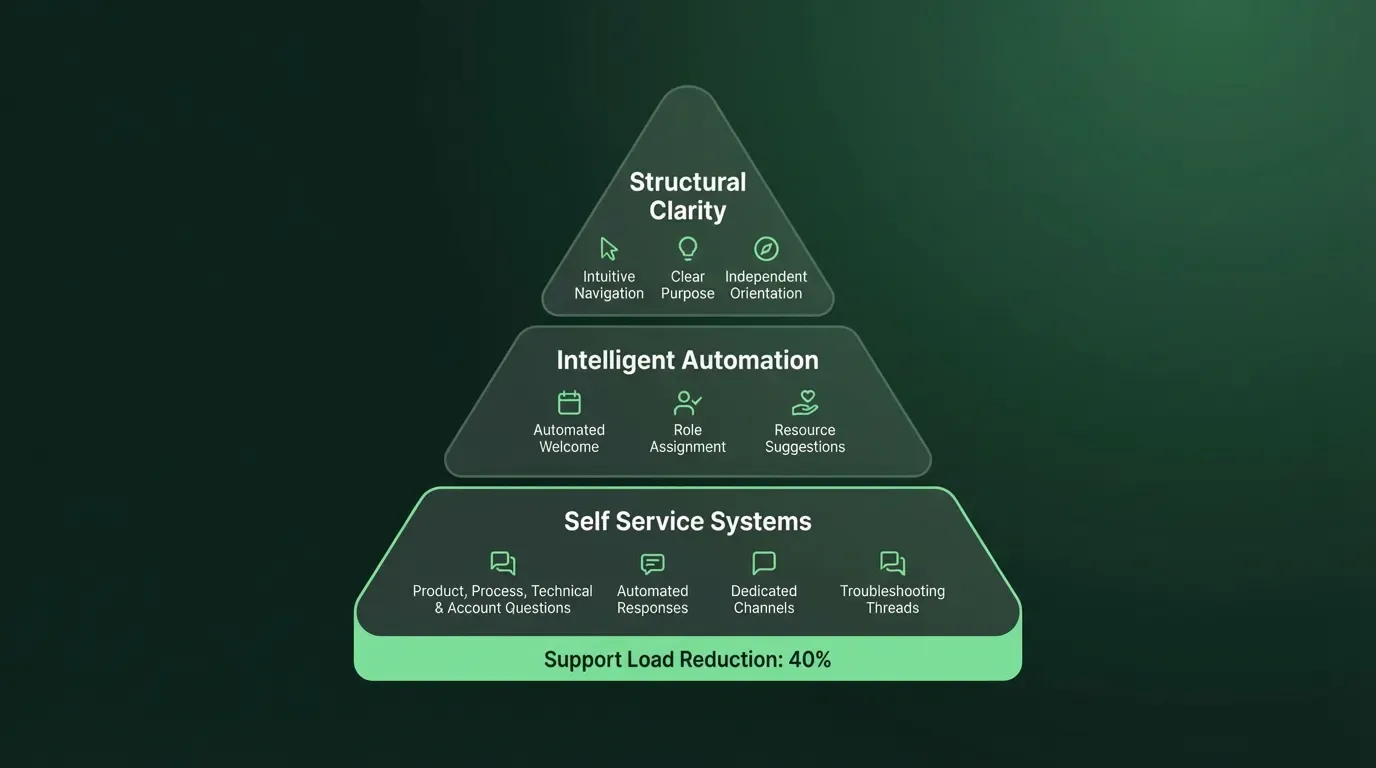
This infrastructure has three layers:
Self Service Systems
Most community questions fall into predictable categories. Product questions. Process questions. Technical questions. Account questions.
In broken communities, these questions generate support tickets. In well structured communities, they generate automated responses.
Not through clunky bots that frustrate users. Through thoughtful information architecture.
Frequently asked questions get dedicated channels with pinned, comprehensive answers. Common workflows get documented with step by step visuals. Technical issues get troubleshooting threads that remain searchable.
The result: members find answers before asking questions.
When this works properly, your support load drops by 40% immediately. Not because questions disappear. Because questions resolve themselves.
Intelligent Automation
The best communities use automation strategically.
New member joins? Automated private thread opens with personalized welcome and clear next steps.
Member completes onboarding? Automated role assignment unlocks relevant channels.
Keyword triggers appear in chat? Automated resource suggestions appear without support team intervention.
This isn't about replacing human connection. It's about freeing your team from repetitive tasks so they can focus on high value interaction.
Structural Clarity
Broken communities make everything hard. Finding information is hard. Understanding next steps is hard. Knowing where to ask questions is hard.
Every point of friction generates support requests.
Well structured communities make the right action obvious. Channel names clearly indicate purpose. Information flows logically. Navigation feels intuitive.
When members can orient themselves independently, they don't need hand holding.
What Happens When You Fix Structure First
That founder I mentioned earlier? We didn't hire three community managers.
We rebuilt his Discord structure over two weeks.
Created a focused onboarding flow. Built a comprehensive FAQ system. Automated routine member interactions. Redesigned channel architecture for clarity.
Three months later, his metrics:
Support tickets down 58%. First response time improved from 4 hours to 20 minutes. Member satisfaction up significantly. And his two existing community managers stopped talking about burnout.
Because they stopped fighting fires.
They now spend their time identifying patterns in remaining support requests and fixing root causes. They refine automated systems. They create educational content. They engage strategically with high value members.
They went from reactive to proactive. Not because they got better at their jobs. Because their job changed when the infrastructure improved.
The Strategic Implications
This matters beyond operational efficiency.
When your community requires constant manual intervention, it can't scale. Your growth is capped by how many people you can hire. Your margins shrink with each new team member.
When your community runs on systems, scale becomes possible.
You can support five thousand members with the same team that struggled with five hundred. You can expand to new markets without expanding headcount proportionally. You can maintain quality while improving economics.
For executives evaluating community as a business channel, this changes the calculation entirely.
Community stops being a cost center that grows linearly with membership. It becomes infrastructure that generates compounding returns.
The Question You Should Be Asking
If you're running a community right now, stop asking: do we need more support people?
Start asking: what support needs could we eliminate through better structure?
Every repeated question is a documentation opportunity. Every manual onboarding step is an automation candidate. Every point of member confusion is a structural flaw.
Your support team sees these problems daily. They're telling you where structure fails by where they spend their time.
Listen to that data.
Then build the infrastructure that makes their current workload impossible.
Because when you build it right, support becomes the easiest part of community management.
And your team becomes the strategic asset they should be.
Stop compensating for broken structure with more headcount. Learn how proper Discord infrastructure reduces support load by 60%
<<<<<<< HEAD