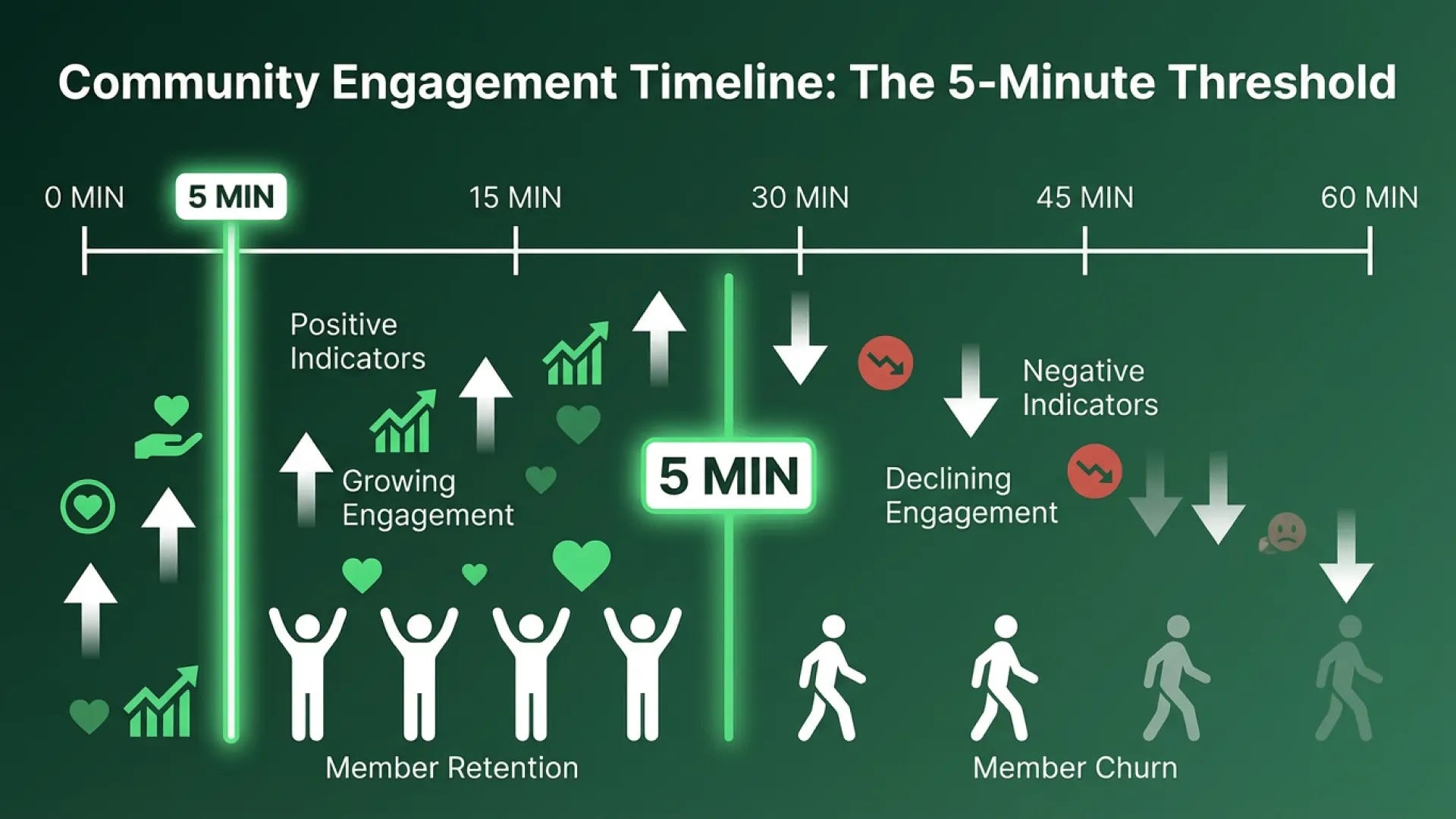
Your response time is killing your retention.
Not your features. Not your documentation. Not your channel structure or your bot setup or your FAQ. Your response time.
I talked to a community manager who was running a crypto project with 8,000 Discord members. They had documentation that covered everything. Every possible question had an answer. Every workflow was mapped out. Every edge case was addressed. They'd spent months building the perfect knowledge base.
And people kept leaving.
She couldn't figure out why. New members would join, ask a few questions, and then vanish. She'd check the logs. The questions weren't complex. Most of them were answered somewhere in the documentation. But the members weren't reading the documentation. They were asking in the support channel and then disappearing.
She started tracking response times. And she found the problem.
Average time to first response: 2.5 hours.
That was the issue. Not the quality of the answers. The time it took to get them.
What Happens in Those Five Minutes
When someone asks a question in your Discord, they're not just asking for information. They're testing whether anyone is actually there.
New members don't trust you yet. They've joined Discord servers before. Most of those servers were dead. Hundreds of members, zero activity. Beautiful documentation that nobody reads. Channels that look active until you realize the last message was from three weeks ago.
So when they ask a question, they're checking. Is this server real? Are there actual humans here? Will someone respond, or is this another graveyard?
You have five minutes to answer that test.
After five minutes, they start multitasking. They open another tab. They check a different community. They move on to something else. By the time you respond two hours later, they've already decided you're not active. Your answer doesn't matter anymore. They're gone.
The crypto project implemented a five-minute rule. If someone asks a question, someone from the team responds within five minutes. Not necessarily with the complete answer. Just with acknowledgment.
"Hey, I see your question. Looking into this now."
That's it. That's the entire message.
Retention jumped 40% in the first month.
Why Acknowledgment Beats Complete Answers
Most teams think they need to have the perfect answer before they respond. They don't.
What members need in the first five minutes isn't the solution. It's proof that someone is there.
When you respond with "I see your question, looking into this now," you've accomplished three things. You've proven a human is monitoring this channel. You've shown that you care about their question. You've kept them engaged long enough to deliver the actual answer.
The full answer can come later. Ten minutes later. Twenty minutes later. Once you've acknowledged them, they'll wait. Because they know someone is working on it.
Without that acknowledgment, they won't wait. They'll assume nobody saw their question. They'll assume this community is dead. They'll leave.
What This Looks Like at Scale
The question everyone asks is how you maintain a five-minute response time when you have 100 questions a day.
You don't need to. You need a five-minute response time for the first question a member asks.
After someone has been in your community for a week, they know you're active. They'll wait for answers. They trust that someone will eventually respond. But new members don't have that trust. They need immediate proof.
So you prioritize. New members get fast responses. Regular members get good responses. You focus your energy on the people who are deciding whether to stay or leave.
The crypto project did this with a simple system. They tagged new members automatically. Anyone with the new member tag who asked a question triggered a notification to the team. Someone would respond within five minutes. After a member had been there for a week, the tag was removed. They'd graduated to the regular support queue.
It worked because they weren't trying to respond to everyone instantly. They were trying to keep the people who were on the fence.
The Real Cost of Slow Responses
When someone asks a question and waits three hours for a response, you're not just losing that person. You're losing everyone who saw the question and noticed nobody answered.
Public channels are public. When a question sits unanswered for hours, everyone can see it. And everyone is drawing the same conclusion. This community isn't actually active. The team doesn't actually care. I should probably leave too.
Fast responses prevent that. When people see questions getting answered quickly, they trust that their questions will get answered quickly too. They stay. They ask their own questions. They participate.
Slow responses create the opposite pattern. Fewer questions. Less participation. Declining trust. Eventually, a dead server.
Getting to Five Minutes
You don't need more people. You need better systems.
Set up notifications for support channels. Make sure someone on your team sees every question immediately. Create simple acknowledgment templates so responding fast doesn't require crafting the perfect message. Rotate coverage so someone is always available during your active hours.
The five-minute rule isn't about being perfect. It's about being present. Show up fast and you'll keep the people who matter.
Your members aren't leaving because you didn't have the right answer. They're leaving because you took too long to respond. Five minutes is the threshold. Faster than that and they stay. Slower than that and they're gone.
<<<<<<< HEAD