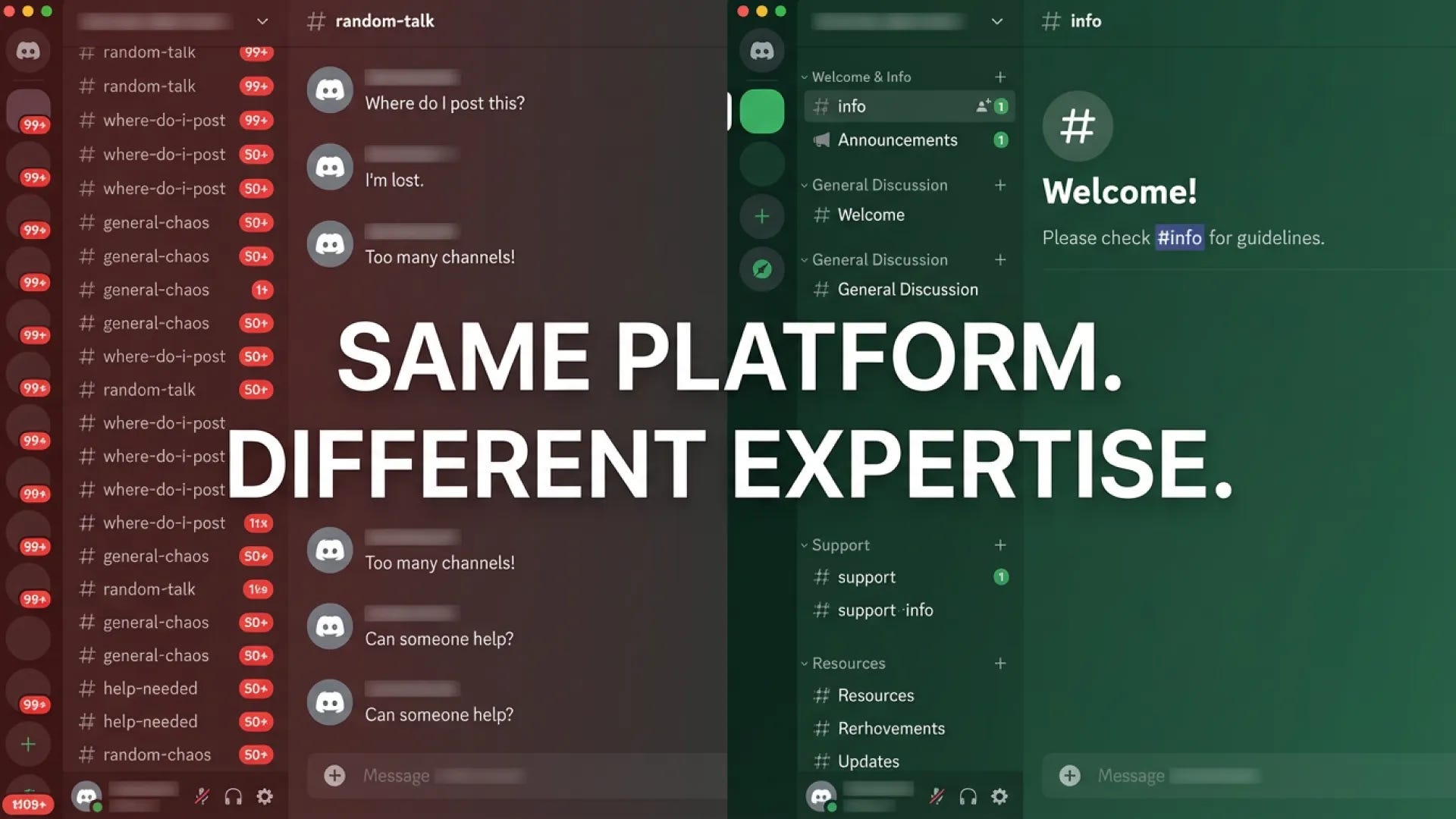
You made what seemed like a smart hire. Someone who understood Discord, had moderation experience, and was excited about building your community.
Six months later, you're dealing with constant drama, members can't find answers to basic questions, and your team is overwhelmed trying to keep things running.
The platform isn't broken. Your Discord isn't cursed. The issue is simpler and more fixable than you think.
The Experience Gap Nobody Talks About
Most people hired to run Discord communities come from gaming servers or small hobby communities. They know how to use the platform. They understand channels, roles, and basic bot commands. They're often enthusiastic and hardworking.
But knowing how to use Discord and knowing how to architect it for business outcomes are completely different skill sets.
Gaming communities tolerate chaos. Business communities cannot. When your Discord drives revenue, supports customers, or retains high-value members, you need systems that function without constant human intervention.
What Inexperienced Management Looks Like
The warning signs show up slowly. Your community manager is always busy but engagement keeps declining. Members complain about unclear structure. Simple questions get asked repeatedly because answers aren't documented. Drama takes days to resolve instead of hours.
The person you hired isn't lazy or incompetent. They're working hard. They just don't have the systems experience to build infrastructure that scales.
They know how to welcome people manually. They don't know how to design onboarding automation that maintains human touch while handling 100 new members per week.
They can answer support questions. They don't know how to build knowledge bases and ticketing systems that reduce repetitive work by 80%.
They moderate conversations. They don't know how to architect role hierarchies that prevent most conflicts before they start.
Why This Keeps Happening
Founders treat Discord community management as junior work because the platform looks simple. Channels, messages, reactions. How hard could it be?
This is like assuming anyone who can use Excel can build financial models for acquisitions. The tool familiarity is just the starting point.
Businesses that generate six or seven figures through Discord communities don't succeed because someone is online answering questions. They succeed because someone built retention systems, engagement loops, support infrastructure, and moderation frameworks that work when humans are offline.
What Actually Scales
Communities that maintain 15% engagement rates while growing past 10,000 members have invisible infrastructure. New member onboarding sequences that turn strangers into active participants within 48 hours. Documentation systems that surface answers before questions get asked. Automation that handles repetitive tasks while preserving the authentic human feel executives worry about losing.
This infrastructure doesn't come from enthusiasm or platform familiarity. It comes from experience building systems that have already scaled.
The Fix
If your Discord feels chaotic despite having dedicated people running it, you probably don't have a people problem. You have a systems problem.
Your team needs architectural support from someone who's built this infrastructure before. Someone who can look at your server and immediately identify the three changes that would reduce your team's workload by half while improving member experience.
This isn't about replacing your current team. It's about giving them the systems and frameworks that let their effort actually scale.
Discord can absolutely drive meaningful business results. But only when it's treated as strategic infrastructure instead of a chat room with enthusiastic moderators.
If your current Discord situation feels overwhelming despite having people running it, the gap is probably expertise, not effort. The platform works when the architecture does.
<<<<<<< HEAD