You've experienced this before. You join a Discord community. You ask a question. A bot responds immediately with a templated answer that almost addresses what you asked, but not quite.
You try to clarify. Another bot response. You attempt to explain your specific situation. The bot sends you a link to documentation.
You leave frustrated, feeling like you tried to have a conversation with a phone tree.
This is what happens when communities automate the wrong things.
The automation temptation
Automation is seductive for community managers. It promises to handle unlimited volume without hiring staff. It offers consistency across all responses. It operates 24/7 without breaks or time zones.
These benefits are real. Automation absolutely has a place in effective community infrastructure. But the temptation is to automate everything possible rather than automating what's appropriate.
The result is communities that feel sterile and corporate even when they're trying to be helpful. Members interact with bots constantly. Every question triggers an automated response. Every action generates a templated message.
Nothing feels personal. Nothing feels human. The community becomes a self-service knowledge base with chat features instead of an actual community.
The automation decision framework
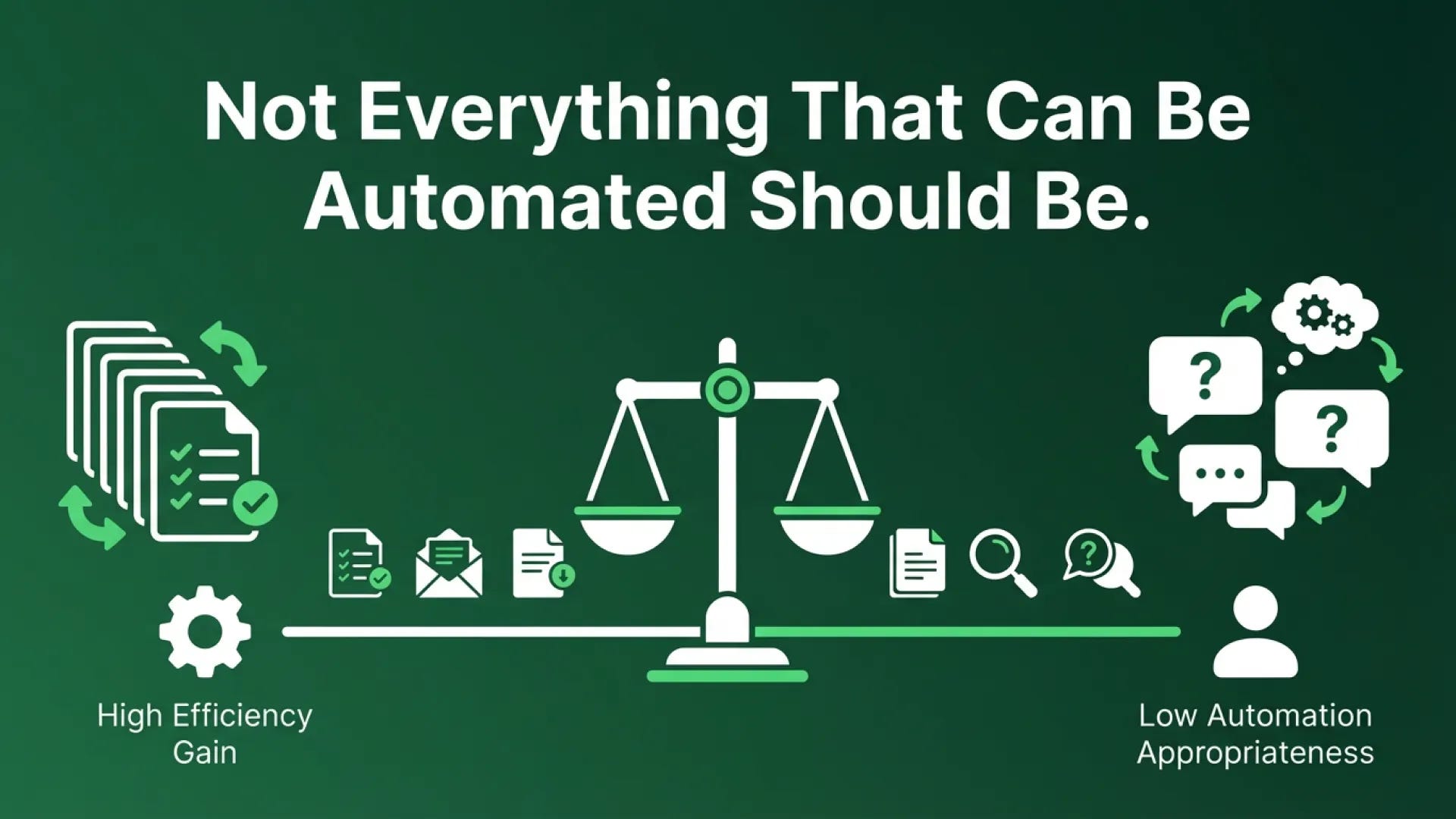
The question isn't whether to use automation. It's what to automate and what to keep human.
The decision boundary is simpler than most people realize. Automate tasks that don't benefit from human judgment. Keep human anything that requires context, nuance, or relationship.
When someone joins your community and needs to know what channels they have access to, that's pure information retrieval. The answer is factual and consistent. There's no judgment required. Automate it completely. Make the response instant, accurate, and reliable.
When someone asks "How does your program work for someone in my specific situation with these particular constraints," that's not information retrieval. That's consultation. It requires understanding context, asking clarifying questions, and potentially offering customized guidance. Keep it human. Make it thoughtful and personal.
The communities that scale effectively while maintaining human feel understand this boundary clearly. Their automation handles the predictable and factual. Their humans handle the nuanced and contextual.
The corporate feel problem
Communities feel corporate when members constantly interact with obvious automation. Not because automation itself is bad, but because it signals that the community prioritizes efficiency over connection.
When every interaction triggers a bot response, members start to feel like they're using a ticketing system rather than joining a community. They're not having conversations. They're submitting queries to an automated processing system.
This is especially problematic in communities that position themselves as high-touch or premium. If someone is paying for access or expects personalized support, constant bot interactions create immediate disconnect between promise and delivery.
The irony is that well-designed automation should be mostly invisible. Members shouldn't constantly notice they're interacting with bots. They should just experience fast responses when appropriate and human attention when needed.
The strategic automation zones
There are three clear zones where automation adds value without creating corporate feel.
First, information distribution. When you need to notify members about updates, changes, or events, automation ensures consistent delivery. Members don't need a personal conversation to learn about schedule changes. They need accurate information delivered reliably.
Second, routine process handling. When someone completes onboarding, triggers role changes, or meets specific criteria for access updates, automation handles these consistently. These are mechanical processes that don't benefit from human judgment.
Third, instant factual responses. When questions have clear, objective answers that never change based on context, automation provides immediate value. Members get instant responses instead of waiting for team availability.
Outside these zones, keep it human. Strategy discussions, complex problem solving, personalized guidance, relationship building, these all require human capacity.
The implementation guidelines
When implementing automation, focus on invisibility for routine tasks and obvious humanity for complex ones.
Your automated responses for factual queries should be so good that members might not even realize they came from a bot. Clear, helpful, and comprehensive enough that follow-up questions are rare.
Your human responses for complex situations should be obviously personal. Use names. Reference specific context. Ask clarifying questions. Show that a real person is thinking about their particular situation.
The transition between automated and human responses should feel seamless. If a bot handles the initial factual response but the member needs more help, route to human support smoothly. Don't make them fight through multiple bot interactions before reaching a person.
The audit question
If your community feels corporate despite good intentions, audit your automation boundaries.
Are you automating responses to questions that actually require judgment? Are your bots trying to handle nuanced conversations? Are members constantly interacting with obvious automation even for complex issues?
If yes, you've automated too much. Pull back. Reserve automation for truly routine tasks. Let humans handle everything that benefits from personal attention.
The goal isn't to minimize human involvement. It's to maximize human impact by removing tedious work that doesn't benefit from personal touch.
Scale without losing humanity
Effective communities use automation to enable human connection, not replace it. They automate the predictable so their team can focus on the valuable.
Members experience instant responses for simple queries and thoughtful attention for complex ones. The community feels responsive and personal even at scale.
That's the difference between automation that enables community and automation that kills it.
Automate the routine. Keep the relationship human.
<<<<<<< HEAD