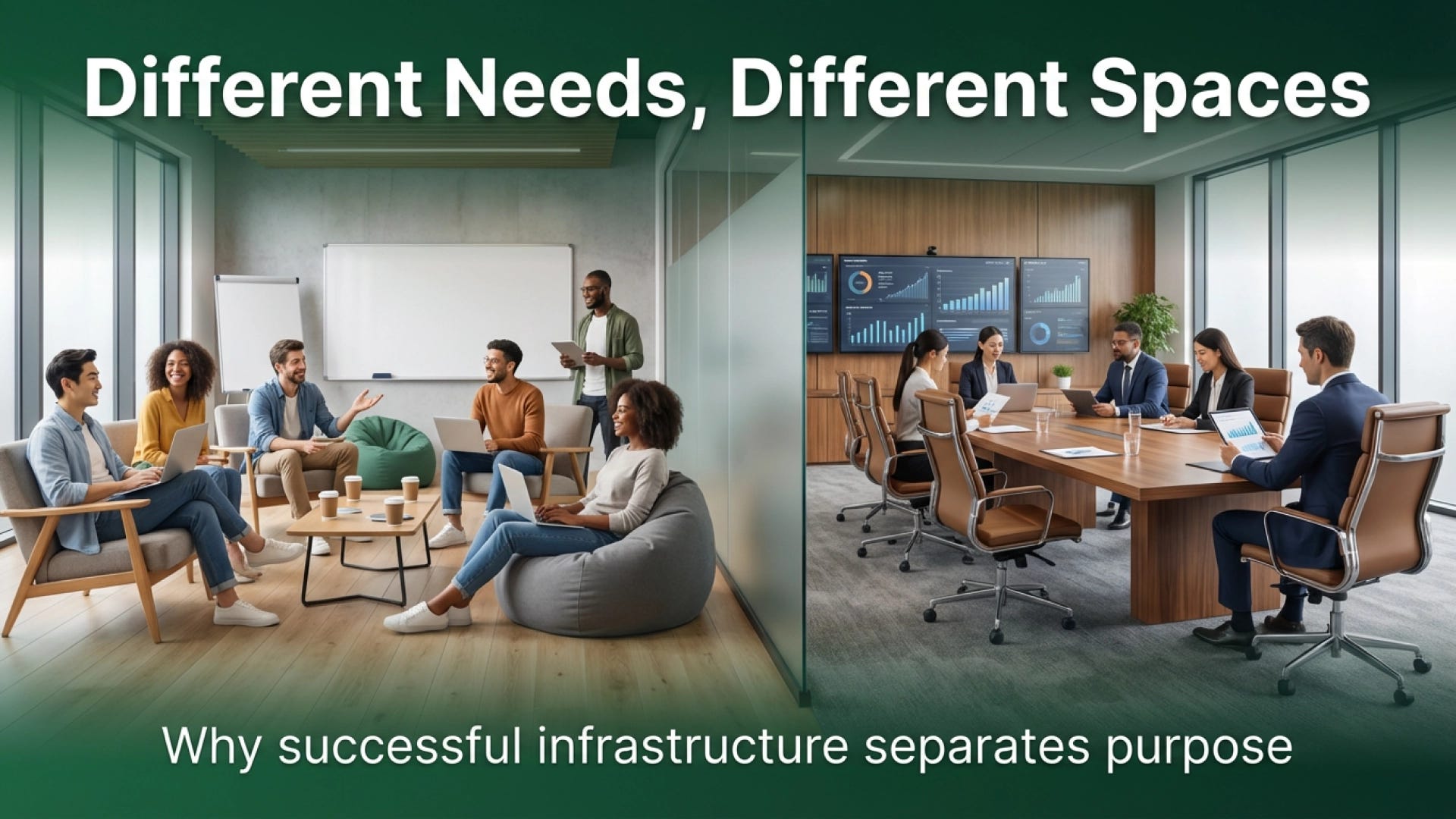
 Your Discord server has creators and company representatives sharing the same channels. It feels collaborative. Transparent. Inclusive.
Until you realize nobody can communicate naturally.
The Mixed Environment Problem
When TikTok shop agencies first build Discord infrastructure, unified channels seem logical. Everyone's part of the same ecosystem. Why separate people?
Then business reality arrives.
Company representatives need to discuss creator performance metrics, address underperforming campaigns, negotiate contract terms, and coordinate operational changes. But they're doing it in channels where hundreds of creators are watching every word.
Conversations that should be direct become diplomatic. Questions that need honest assessment get softened for public consumption. Business discussions that should take two minutes stretch to twenty because everything must be carefully worded to avoid misinterpretation.
Meanwhile, creators need community. They want to connect with peers, share experiences, ask questions that might reveal uncertainty, and build relationships without constant company monitoring.
But company stakeholders are in every channel. So community conversations stay surface-level. Creators don't share real frustrations because management is watching. They don't ask questions that might make them look inexperienced. They don't build peer relationships because the environment feels professionally observed rather than authentically communal.
You've created an environment where business communication can't be direct and community communication can't be authentic.
What Separated Infrastructure Enables
Agencies successfully managing 30+ brands build different environments for different purposes within the same server.
Creator channels focus on community infrastructure. Peer support, resource sharing, question answering, success celebration, challenge discussion. These channels feel like community because they are community. Company representatives aren't monitoring every conversation or inserting themselves into peer discussions.
Company channels focus on business infrastructure. Performance reviews, strategic updates, operational coordination, contract discussions. These channels enable direct business communication because creators aren't spectating every internal conversation.
The separation isn't about secrecy or exclusion. It's about appropriate context.
When a company representative needs to address declining creator performance for a specific campaign, they can do it directly in company channels with relevant stakeholders. Not in public channels where the conversation becomes performative.
When creators want to discuss their experiences with payment timelines or content approval processes, they can do it honestly in community channels. Not in mixed spaces where company monitoring makes honest assessment feel risky.
The Information Flow Question
Separation doesn't mean isolation.
Strategic company updates get shared in creator channels when appropriate. Product launches, program changes, new opportunities all flow to creators through structured announcements.
Creator feedback reaches company stakeholders through designated channels or support systems. The separation doesn't block information flow. It creates appropriate pathways.
But the day-to-day environments remain distinct. Business discussions happen in business contexts. Community conversations happen in community contexts.
The Environment Design Principle
Here's what mixed environments create: compromise.
Business stakeholders can't communicate as directly as they need. Creators can't build community as authentically as they deserve. You've built infrastructure that partially serves everyone instead of fully serving anyone.
Here's what separated environments create: optimization.
Each group gets infrastructure designed specifically for their needs. Business channels enable the direct communication that operational coordination requires. Community channels enable the authentic peer connection that creator retention requires.
Your server becomes more functional for everyone, not because you've added restrictions, but because you've created appropriate contexts.
The Scale Reality
Agencies managing five brands might operate in mixed channels successfully. The volume is low enough that compromise environments still function.
Agencies managing 30+ brands cannot.
The business communication load becomes too heavy to handle diplomatically in public channels. The community size becomes too large for authentic connection when authority is always present.
Separation isn't a nice-to-have feature. It's infrastructure that determines whether you scale past 20 brands or collapse under communication dysfunction.
If your creators and company representatives share all the same channels, ask yourself: are business discussions as direct as they need to be? Are community conversations as authentic as they should be?
If the answer is no to either question, you don't have an inclusion problem.
You have an infrastructure problem. And separated environments are the solution.
Different purposes require different environments. Mixing everything isn't inclusion. It's compromise.
<<<<<<< HEAD