TikTok shop agencies discover the scaling problem around their third or fourth brand partnership.
You're managing creator networks across multiple companies. Each brand has different commission structures, content requirements, and payout schedules. Creators need constant clarification. Brands want regular updates. Your team spends half their day answering the same questions through different channels.
Email threads get buried. DMs pile up across platforms. Slack channels become graveyards of unanswered questions. Nothing stays organized long enough to be useful.
The instinct is to add more people. Hire another coordinator. Bring on a support specialist. But adding headcount to broken systems just creates expensive chaos instead of cheap chaos.
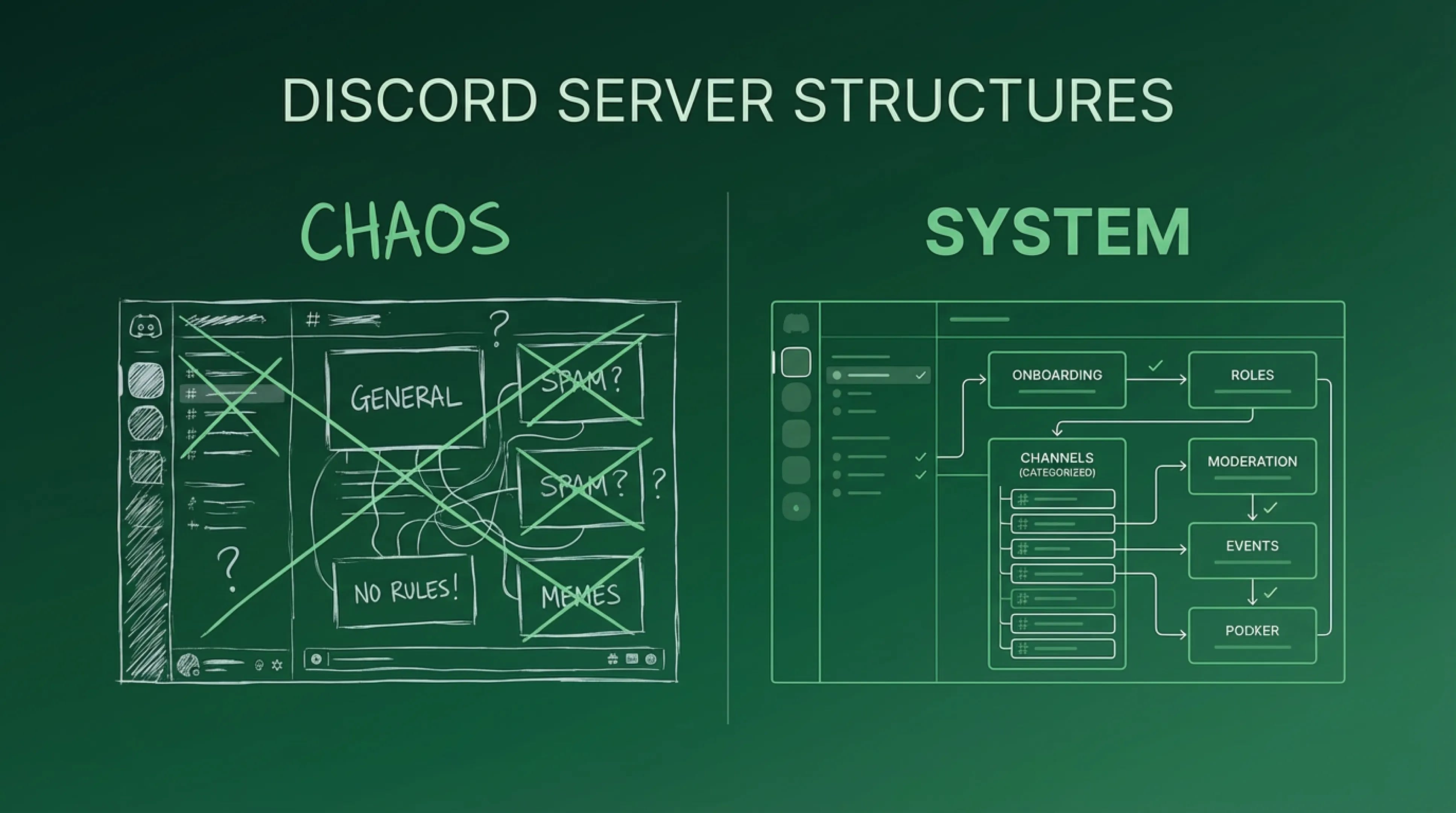
The real problem is treating Discord like a messaging app instead of business infrastructure.
Most agencies approach Discord as "the place where our community hangs out." They create a server, set up a few channels, invite everyone, and expect it to work. When engagement stays flat and support requests keep flooding other channels, they assume Discord isn't right for their business.
They're not wrong about Discord. They're wrong about what Discord should be doing.
Infrastructure vs. Communication
Discord becomes valuable the moment you stop thinking about it as a place for conversations and start building it as the system that routes, organizes, and resolves everything automatically.
Proper Discord infrastructure handles three jobs that destroy agency capacity:
Onboarding at scale.
When a new creator joins, they shouldn't need a person to explain everything. Automated welcome sequences walk them through verification, role selection, and resource access. Custom bots assign permissions based on which brands they're working with. Knowledge bases answer standard questions before they're asked.
The creator gets exactly what they need without waiting. Your team doesn't spend an hour per person explaining the same process.
Support without drowning.
Ticket systems replace DM chaos. When a creator has a question about commissions, they open a ticket. It routes to the right team member. Context stays contained. Resolution gets documented. The next person with the same question finds the answer in your searchable archive instead of asking again.
Your support hours drop while response quality improves.
Retention through systems, not effort.
Recognition systems automatically highlight top performers each week. Community events create networking opportunities without manual coordination. Challenges and engagement prompts keep creators active between campaigns.
Retention improves because the system creates value consistently, not because someone remembers to do it manually.
The Agencies That Scale
Agencies managing twenty-plus brands simultaneously aren't superhuman. They built infrastructure before they needed it.
When they take on a new brand partnership, onboarding is already systematized. Support channels are already structured. Creator retention programs are already running. Adding another brand means duplicating a working system, not reinventing the wheel.
The agencies stuck at five brands keep treating each new partnership as a unique challenge requiring custom solutions. They're rebuilding the plane mid-flight every time.
What Proper Setup Actually Looks Like
Structured Discord infrastructure for TikTok shop agencies includes:
Automated verification and onboarding flows that route creators to brand-specific channels based on their partnerships. No manual sorting. No waiting for access.
Tiered knowledge bases organized by topic and brand, searchable and constantly updated. Creators find answers faster than asking questions.
Support ticket systems that categorize issues, route to appropriate team members, and create documentation automatically. Every resolution makes the next one faster.
Brand-specific channels with clear purposes. Updates go in one place. Questions go in another. Casual networking has its own space. Nobody wastes time figuring out where to post.
Recognition and engagement automation that highlights achievements, prompts interaction, and creates retention without manual effort from your team.
This setup doesn't happen overnight. But it happens once. After that, scaling is replication rather than reconstruction.
The Cost of Waiting
The most expensive time to build infrastructure is after you need it.
When you're already drowning in support requests and scrambling to onboard new creators across multiple brands, you don't have capacity to step back and systematize. You're in triage mode, handling today's fires instead of preventing tomorrow's.
Agencies that build Discord infrastructure early create capacity. Agencies that wait until chaos forces them to build it use their last reserves of energy trying to organize while everything's burning.
The pattern is consistent: agencies that treat Discord as infrastructure before scaling move faster and retain more creators than agencies that bolt it on as an afterthought.
Starting Point
If you're running a TikTok shop agency and Discord currently feels like another place to check instead of the system organizing everything, that's the signal.
You don't need more hustle. You need infrastructure that handles complexity before it becomes crisis.
The agencies outpacing you aren't working longer hours. They're working inside systems that do the heavy lifting automatically.
Book a 30-minute call to map out what proper Discord infrastructure looks like for your agency's specific structure and scaling goals.
<<<<<<< HEADSchedule a Discord Infrastructure Review - ashraful.systems