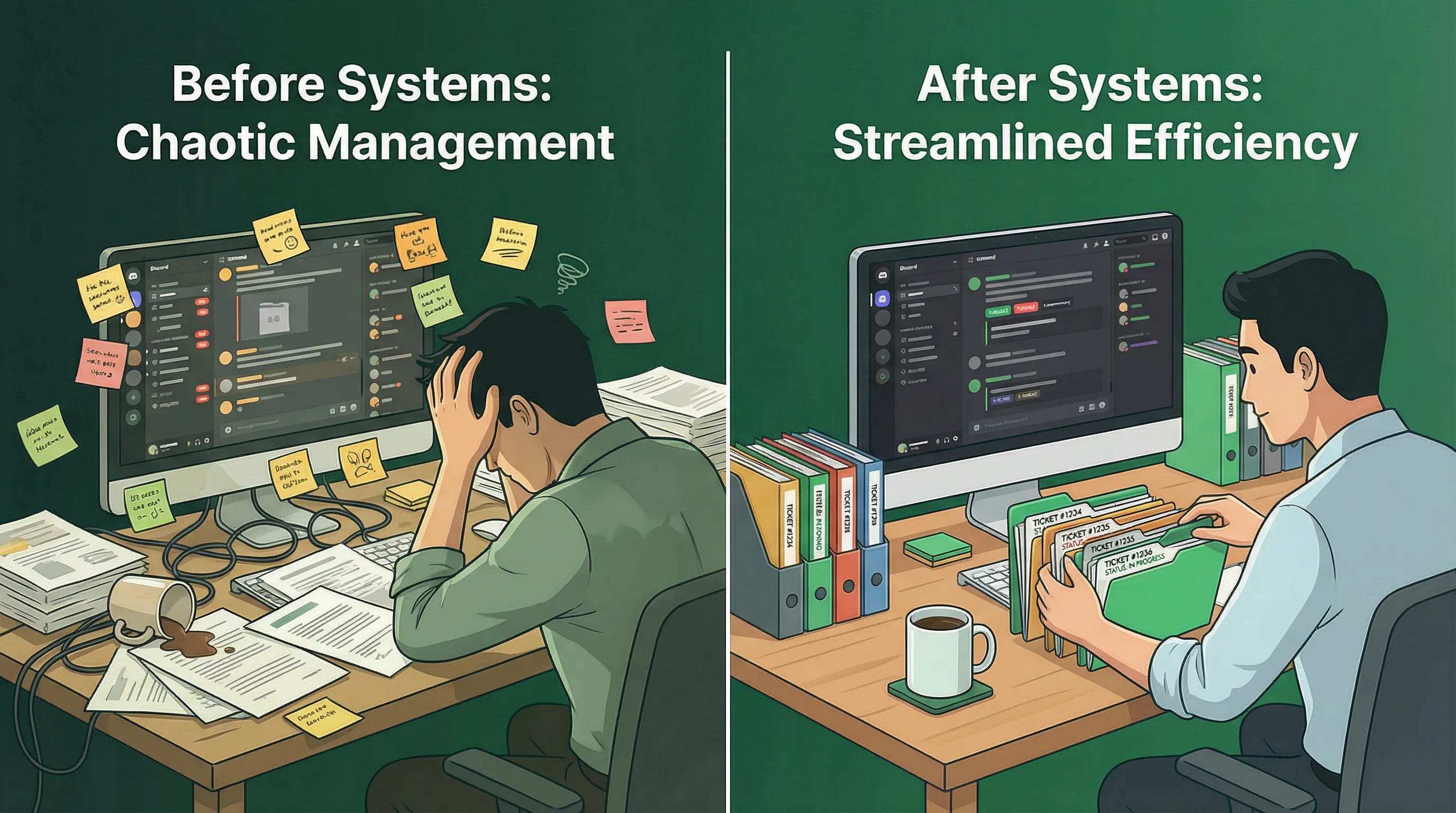
Your Discord has 300 paying members. Half of them need help with something this week.
Some have billing questions. Others need technical support. A few want feature requests. Several are reporting bugs.
If you're handling all of this in one general support channel, you're already failing.
Open chat support creates three immediate problems. First, questions get buried under conversation volume. Someone asks how to reset their password at 2pm. By 3pm, there are 40 new messages and nobody saw the question. Second, there's no ownership. Your team doesn't know who's handling what, so either everyone responds or nobody does. Third, there's no tracking. You have no idea if issues are being resolved or how long members are waiting.
Ticket systems solve all three problems with one mechanism.
When a member needs help, they click a button to open a ticket. A private thread is created between them and your support team. One issue, one conversation, zero noise. Your team member claims the ticket, handles the problem, closes the thread when it's resolved.
The system tracks everything. How many tickets are open. Who's assigned to what. Average response time. Resolution rate. You can see patterns. You can identify bottlenecks. You can improve.
I worked with a TikTok Shop agency managing creator support through Discord. They started with an open support channel. Creators would ask about payment processing, content guidelines, technical issues, all in the same place. The channel had 200 messages a day. Questions were getting missed. Creators were frustrated. Some left the program.
We implemented a ticket system. Creators clicked a button, described their issue, got a dedicated thread with a support agent. Response time dropped from hours to under 30 minutes. Resolution rate went from 60% to 95%. Creator satisfaction jumped because they knew someone owned their problem.
The system also revealed patterns they couldn't see before. 40% of tickets were about the same payment processing question. They added it to the FAQ, reduced tickets by half. Another 20% were technical issues with one specific integration. They fixed the integration, eliminated an entire category of support burden.
Tickets create accountability that open chat can't provide. When a member opens a ticket, they receive confirmation that someone will help them. They can see the status. They know it won't get lost. When your support team looks at the queue, they see exactly what needs attention. No more scrolling through 500 messages hoping they didn't miss something urgent.
The implementation is straightforward. You need a ticket bot. Members interact with it through a button or command. The bot creates a thread. Your team gets notified. They claim and resolve tickets. The bot tracks metrics.
You can customize based on your needs. Add categories for different issue types. Route tickets to specific team members based on expertise. Set SLAs for response times. Create escalation paths for urgent issues.
Open chat support works in casual communities where nothing is time sensitive and nobody's paying. If you're running a business where support quality affects retention and revenue, you need structured systems.
Your competitors are still using open channels. Their members are frustrated. Their team is overwhelmed. You can win by implementing the basic infrastructure that professional support requires.
Tickets aren't complicated. They're just organized. And organization is what separates communities that scale from communities that collapse under their own volume.
<<<<<<< HEAD