A CFO asked me to justify their Discord community investment.
"Show me the revenue it generates," he said.
I told him: wrong question.
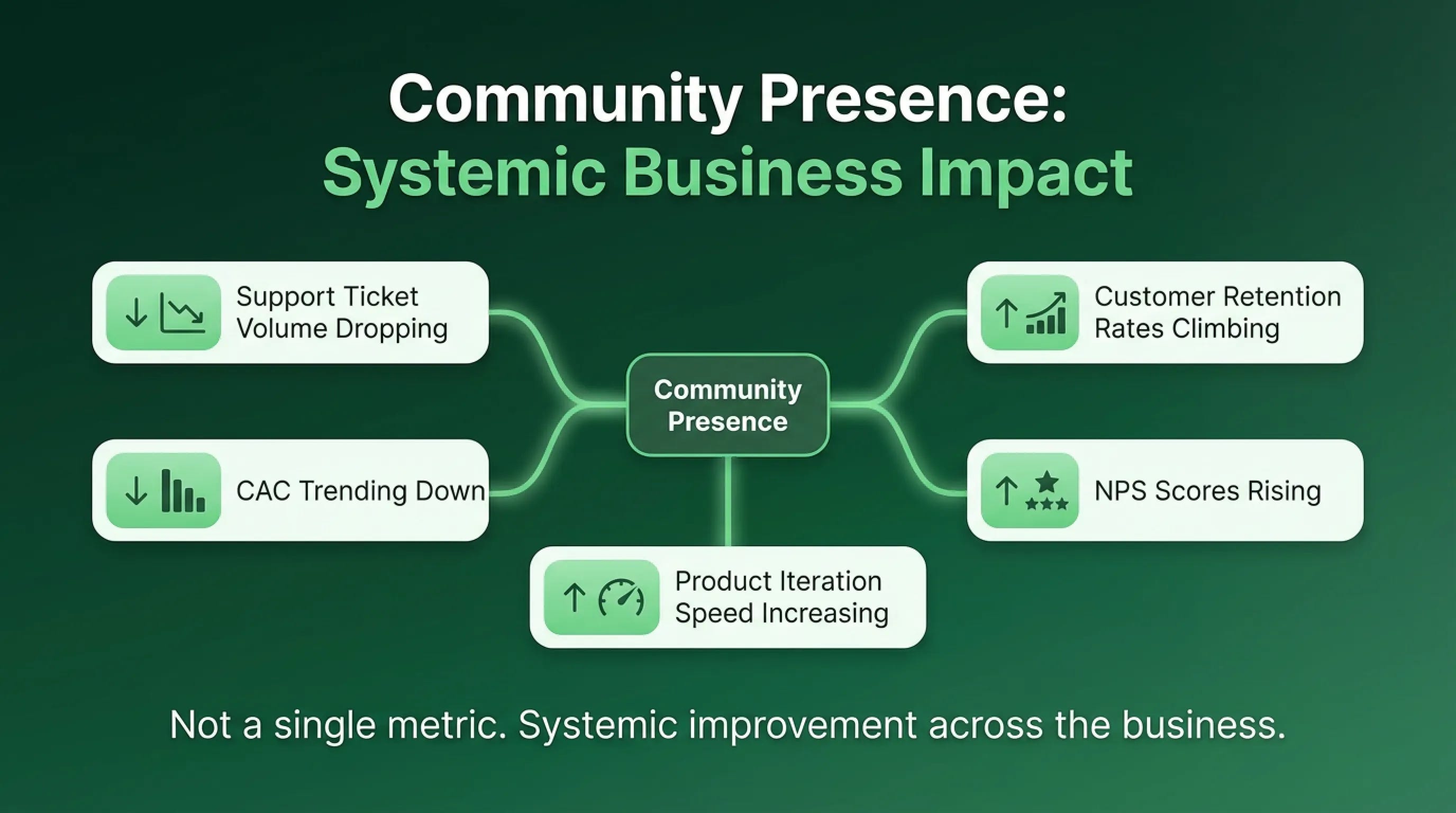
His community wasn't generating revenue. It was reducing costs, improving retention, and lowering acquisition costs simultaneously.
The value was an order of magnitude higher than direct revenue would be.
But his measurement framework couldn't see it.
The Revenue Attribution Trap
When executive teams evaluate channels, they default to revenue attribution.
How many sales came from this campaign? What conversion rate does this channel produce? What's the revenue per visitor?
This framework works for many channels.
It fails completely for community.
Because community value doesn't flow through linear conversion paths. It flows through compound effects across multiple business functions.
Trying to measure community through revenue attribution is like trying to measure logistics infrastructure through revenue attribution. The value isn't in what it sells. The value is in what it enables.
Where Community Value Actually Lives
Companies making millions from Discord communities see value in places finance teams don't traditionally look.
Support Cost Reduction
When members answer each other's questions, support ticket volume drops.
For a company handling thousands of support tickets monthly, this matters economically.
Example: company with 5,000 monthly tickets, average handling cost of $15 per ticket, monthly support cost of $75,000.
Active community reduces tickets by 40%. Monthly savings: $30,000. Annual savings: $360,000.
This isn't revenue. It's direct cost reduction. In many ways, more valuable than revenue because it drops straight to profit.
Retention Improvement
Members of active communities churn at measurably lower rates.
Why? Because community creates switching costs. Leaving your product means leaving your community. Many customers won't make that trade.
Example: SaaS company with 10,000 customers, $100 monthly subscription, 5% monthly churn.
Community engagement reduces churn to 3.5%. The 1.5% improvement retains 150 additional customers monthly.
Lifetime value impact: massive. Over twelve months, that's 1,800 customers retained who would have churned. At $100 monthly, that's $2.16 million in preserved annual revenue.
Again, this doesn't show up as community generated revenue. It shows up as improved retention metrics.
But the economic impact is identical to revenue generation.
Acquisition Cost Improvement
Community members refer others. Referrals convert at higher rates and cost less to acquire than paid channel customers.
Example: company spending $200 per acquisition through paid channels.
Community drives 200 referral signups monthly. Effective acquisition cost for referrals: $50 (the cost of community operations divided by referrals).
Monthly savings: $30,000. Annual savings: $360,000.
Plus, referred customers often have better lifetime value and retention than paid channel acquisitions.
The economic impact compounds.
Product Development Efficiency
Active communities provide immediate feedback.
Instead of waiting for quarterly surveys or scheduled user interviews, product teams get real time signal on what works and what doesn't.
This accelerates iteration. Faster iteration means better product market fit.
Harder to quantify precisely. But faster time to product market fit has enormous economic value.
Companies that reach fit months earlier capture market share competitors don't. They achieve profitability sooner. They require less total capital.
Brand Advocacy Creation
Engaged community members create content, defend your brand, and reduce marketing requirements.
They write reviews. They create tutorials. They answer questions on social media. They recommend your product without prompting.
This reduces marketing spend. Not by replacing marketing entirely, but by making marketing more efficient.
User generated content converts better than company created content. Peer recommendations carry more weight than advertising.
Quantifying this precisely is difficult. But the directional impact is clear: active community reduces marketing cost per acquisition.
The Compound Effect
Here's what makes community infrastructure particularly valuable: these effects stack.
Support cost reduction happens simultaneously with retention improvement. Acquisition cost improvement happens while product development accelerates. Brand advocacy grows while all other effects compound.
Company with active community sees:
$360,000 annual support cost reduction.
$2.16 million preserved annual revenue from improved retention.
$360,000 annual savings from improved acquisition economics.
Unquantified but significant value from faster product development and brand advocacy.
Total measurable annual impact: $2.88 million.
Cost to operate community: $200,000 annually (community manager, tools, operations).
Net value: $2.68 million.
ROI: 1,340%.
This isn't direct revenue attribution. This is infrastructure value measurement.
And this example uses conservative numbers. Companies with larger communities or higher customer values see proportionally larger impact.
Why Finance Teams Miss This
Traditional finance measurement frameworks struggle with community value because they're built for linear attribution.
Channel X generated Y revenue. Campaign A produced B conversions.
Community doesn't fit this model.
Community reduces costs in support while improving retention in customer success while lowering acquisition costs in marketing while accelerating iteration in product development.
Measuring any single function understates value. The value lives in simultaneous improvement across functions.
Finance teams accustomed to single channel attribution will systematically undervalue community infrastructure.
They'll look for community revenue. They'll miss community infrastructure value.
The Right Measurement Framework
Companies getting community ROI measurement right track these metrics:
Support ticket volume change after community launch.
Customer retention rate by community engagement level.
Referral rate and acquisition cost for community driven signups.
Product iteration speed before and after community feedback access.
User generated content volume and marketing cost per acquisition trend.
They don't track: community generated revenue.
They track: business function improvement enabled by community.
Different question. Different data. Different answer.
What This Means Practically
If you're building business case for community investment:
Don't pitch community as revenue channel.
Pitch community as infrastructure that improves economics across support, retention, acquisition, product development, and marketing.
Provide specific projections for each function.
Example: based on industry benchmarks, active community typically reduces support tickets by 30 to 50 percent. At our current ticket volume and handling cost, this translates to X annual savings.
Repeat for each function.
Total the economic impact.
Compare to community operation costs.
Show ROI as infrastructure investment, not marketing channel investment.
This framing matches how community actually creates value. And it provides measurement framework that captures real impact instead of understating it.
The Pattern That Matters
Executive teams making millions from Discord communities understand this:
Community isn't channel.
Community is infrastructure.
Infrastructure value doesn't show up as channel revenue. It shows up as improved economics across every channel.
Measure accordingly.
That's where the value lives.
Most executive teams are leaving millions on the table by measuring community value wrong. They're using revenue attribution frameworks for infrastructure assets. The measurement mistake causes systematic undervaluation. Companies that fix the measurement framework consistently see 10x higher perceived value from community investment, because they're finally measuring what actually matters: compound infrastructure value across multiple business functions simultaneously.
<<<<<<< HEAD