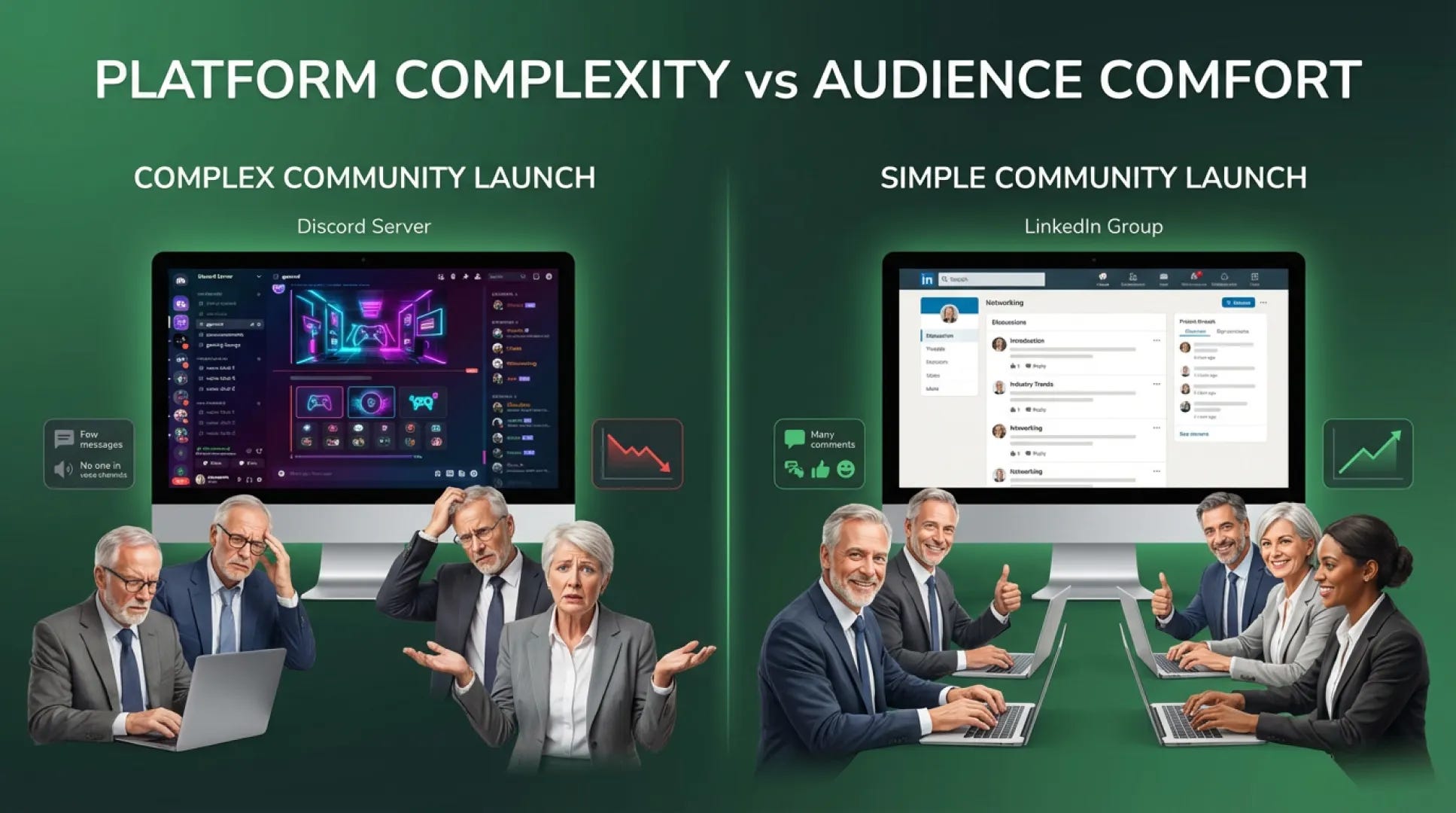
You're launching a premium community for business executives evaluating enterprise software. You research successful communities. Discord keeps appearing. Successful startups build on Discord. Tech communities thrive on Discord. You decide to build on Discord.
You invest weeks setting up channels, configuring bots, creating onboarding flows. You invite your first 100 members. They're VPs and directors at Fortune 500 companies. Average age is 48. Most have never used Discord. Some have barely heard of it.
They join your server. They see an interface designed for gamers. Channels with names that reference internet culture. Voice channels they don't understand. A complexity level they didn't expect from a business community.
Most leave within minutes. The few who stay never post. Six months in, you have 300 members and maybe 10 messages per month. You built a beautiful Discord server for an audience that will never use Discord.
This happens when founders choose platforms based on trends instead of audience behavior.
Discord is an excellent platform. For specific audiences. Tech savvy users who already use Discord or similar tools. Gaming adjacent communities where Discord is the default. Younger demographics comfortable with complex interfaces. Communities built around real time discussion and voice communication.
If your audience fits that profile, Discord is probably the right choice. If your audience is corporate executives who've never used Discord, it's probably wrong regardless of how many successful Discord communities exist.
The platform decision should answer one question: where does my audience already spend time and what interfaces are they comfortable with.
If your audience is on LinkedIn daily, build on LinkedIn. The friction of learning a new platform disappears when you meet people where they are. If they're comfortable with Facebook, Facebook Groups makes sense despite being less sophisticated. If they're mobile first international users, WhatsApp provides better adoption than any web platform.
I consulted with a founder building a community for creative agency owners. She wanted Discord because that's where successful creator communities live. I asked about her audience. Agency owners aged 35-55. Most running 7 figure businesses. Tech comfortable but not tech native. Time constrained and busy.
I suggested Circle or a simple Slack community instead. Discord would create unnecessary friction. Her audience wouldn't invest time learning a gaming platform to access a business community. She disagreed and built on Discord anyway.
Six months later: 250 members, engagement was nonexistent. She'd post discussions that got zero responses. She'd schedule events that nobody attended. The community felt dead despite having hundreds of members.
The problem wasn't her content or her value proposition. The problem was platform friction. Her audience didn't want to learn Discord. They had Slack for work, LinkedIn for professional networking, and email for everything else. Adding Discord to that stack felt like homework.
We moved the community to Circle. Same content, same value proposition, different platform. Engagement jumped immediately. Members could access content through a web browser. The interface felt familiar. Video hosting worked smoothly. Progress tracking provided structure. Within two months, the community had higher engagement than Discord ever achieved.
The lesson is that platform capabilities matter less than platform adoption. Discord has more features than Circle. But if your audience won't use Discord, those features are worthless. Circle has fewer features but if your audience will actually log in, the features it has create more value.
The practical framework considers audience demographics, technical comfort level, and existing platform habits. Younger tech savvy audiences fit Discord. Older professional audiences fit LinkedIn or simple web platforms. International mobile audiences fit WhatsApp. Existing Facebook users fit Facebook Groups.
Course delivery needs video hosting and progress tracking, suggesting Circle or similar platforms. Real time discussion and voice chat suggests Discord or Slack. Asynchronous discussion suggests forums or LinkedIn. Mobile first suggests WhatsApp or Telegram.
The mistake founders make is choosing platforms based on what's working for other communities without considering whether those communities serve similar audiences. A Discord community for software engineers tells you nothing about whether Discord works for management consultants.
Your competitors are building on trendy platforms their audiences won't use. They're confused why adoption is low despite following best practices. You can choose platforms based on where your audience lives and watch adoption happen naturally.
Platform trends don't matter. Audience habits do. Build where your people already are.
The best platform is the one your audience will actually use. Everything else is optimization.
<<<<<<< HEAD