There's a predictable breaking point in every growing community.
Early on, support is manageable. A few questions per day. You answer them personally. It feels good to be responsive. Members appreciate the quick help.
Then you scale. More members join. Questions multiply. What used to take an hour now takes four. You hire someone to help. They get overwhelmed too. You consider hiring another person.
This is where most communities make a critical mistake. They try to solve an infrastructure problem with headcount.
The pattern recognition problem
When you're deep in support work, every question feels unique. Someone asks about verification. Another person asks about channel access. A creator wants to know about payment timelines.
But if you step back and track these questions over a month, something becomes obvious. About 70% of all questions are variations of the same 10 queries.
How do I verify my account? Where do I find X resource? Why can't I access this channel? When do payments process? How do I contact someone directly?
These questions don't need human intelligence to answer. They need consistent, immediate, accurate information. That's a systems problem, not a people problem.
The three-layer infrastructure
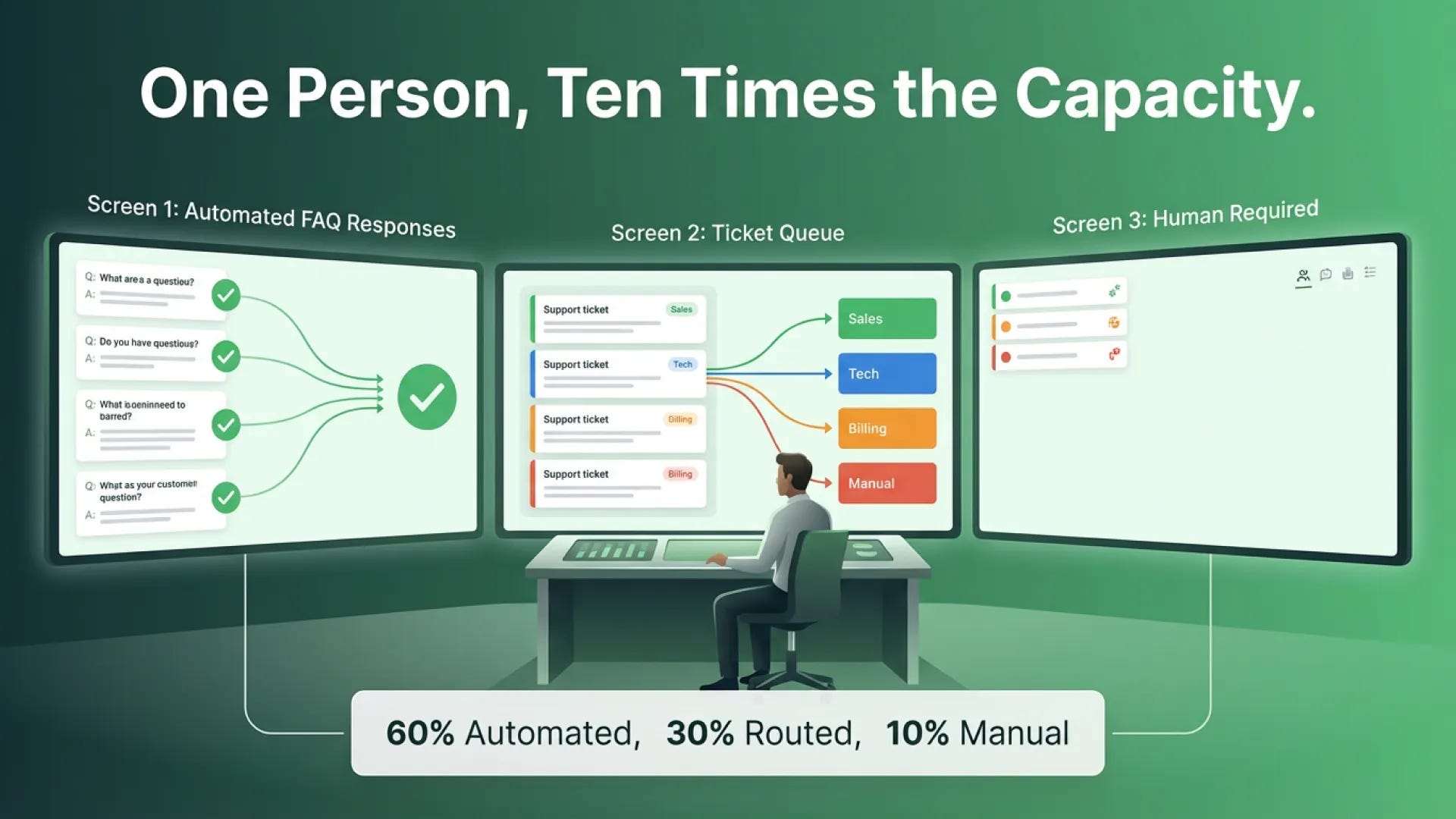
Effective community support operates in three distinct layers.
The first layer is FAQ automation. Before someone can ask their question, the system surfaces likely answers. This handles about 60% of all queries without any human involvement.
The second layer is a ticket system with smart routing. Complex questions that need human attention get automatically directed to the right team member based on topic and expertise. This handles about 30% of queries.
The third layer is direct human support for situations that genuinely require personalized attention, nuanced judgment, or escalation authority. This is roughly 10% of all queries.
When you build all three layers, one support person can handle the volume that used to require five.
Why teams resist this
The most common objection I hear is about losing the personal touch. People worry that automation makes communities feel corporate and distant.
But this is backwards thinking. When your team spends all day copying and pasting the same answers, nobody gets personalized attention. The members with simple questions wait hours for generic responses. The members with complex problems get rushed answers because your team is overwhelmed.
Automation doesn't remove the human element. It reserves human capacity for situations where it actually matters.
When someone joins your community and needs to know which channels they can access, they don't need a personal conversation. They need instant, accurate information. When someone has a nuanced problem that requires judgment, they need focused attention from someone who isn't mentally exhausted from answering "how do I verify" for the 50th time that week.
The implementation sequence
Start by tracking every support question for two weeks. Categorize them. Identify the repeating patterns.
Build FAQ automation for the top 10 most common questions. Implement a ticket system that routes queries by category. Train your team on when to escalate versus when to resolve directly.
Measure your resolution rates by layer. If more than 15% of queries are reaching human support, your automation layer needs improvement. If ticket routing is taking more than two hours, your categorization needs refinement.
The agencies I work with typically see 70-80% reduction in manual support workload within 30 days of implementing this infrastructure. Their teams report higher job satisfaction because they're solving interesting problems instead of answering the same questions repeatedly. Members report faster response times and better overall experience.
Scale without burning out
Growth shouldn't make your team miserable. If adding members means adding support burden in linear proportion, you're building the wrong systems.
Build infrastructure that handles the predictable. Reserve human capacity for the valuable. Scale efficiently.
Your team's time is too valuable to waste on questions that can be automated.
<<<<<<< HEAD