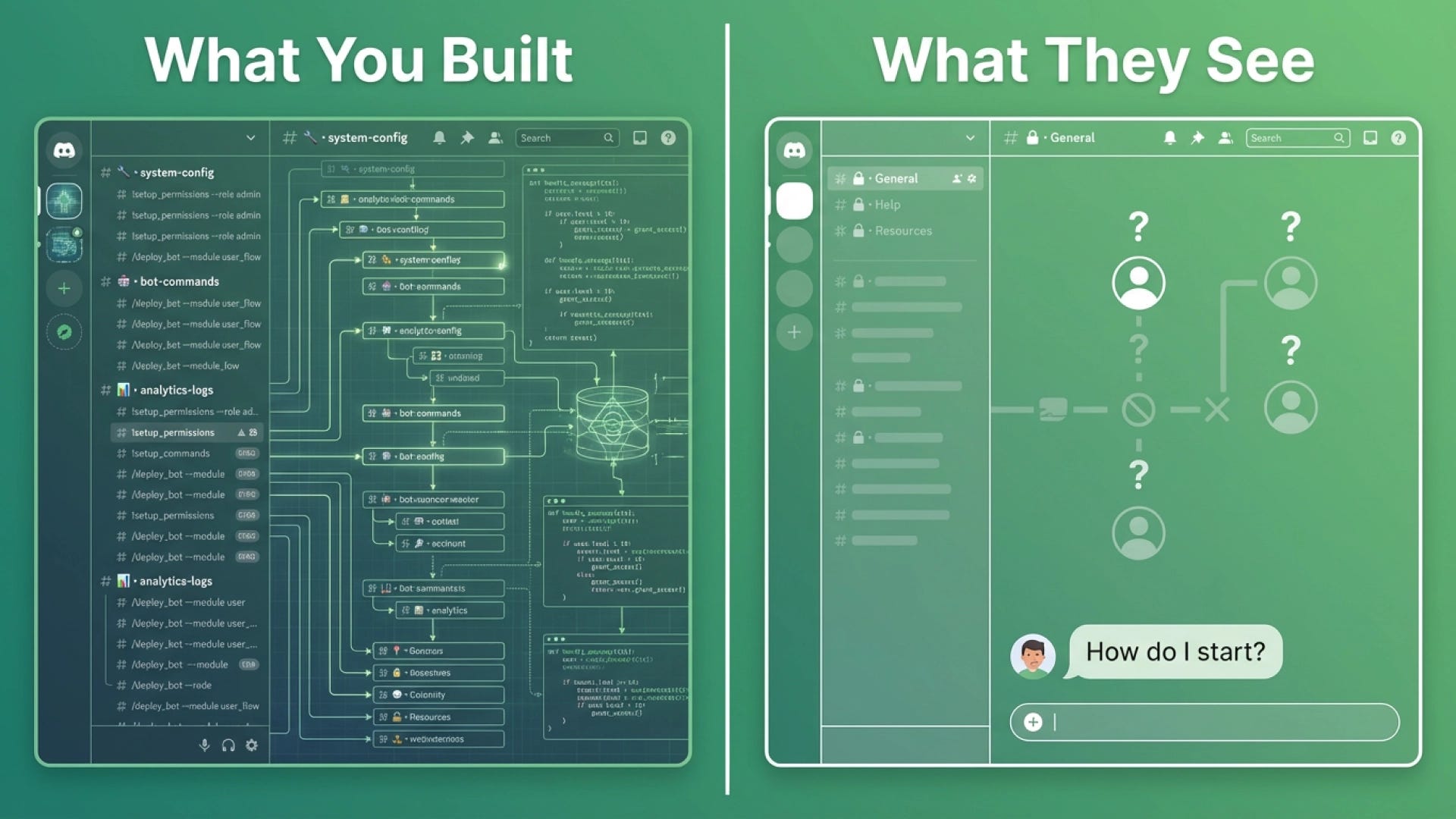
The most technically sophisticated Discord servers are often the least used.
I talked to a founder running an AI gaming startup who spent months building a Discord server with custom functionality. They wrote their own bots. They integrated their AI generation system directly into Discord. Users could type prompts in channels and get AI-generated game assets within seconds.
Characters. Environments. Gameplay mechanics. All generated in real-time through Discord commands.
It was technically impressive. They'd solved complex problems. The API integration was clean. The bot responses were fast. The system worked exactly as they'd designed it.
And almost nobody was using it.
When I asked why, the answer became obvious within five minutes of looking at their server. Someone would join. They'd ask a simple question in the general channel. "How do I get started?"
There was no clear answer. The onboarding documentation assumed you'd read through the technical specs. The channel structure assumed you understood their workflow. The bot commands assumed you knew what you wanted to generate.
The entire server was optimized for technical capability, not human usability.
What Technical Founders Optimize For
When technical founders build Discord servers, they optimize for things that matter to them. Clean architecture. Efficient automation. Sophisticated integrations. Systems that do exactly what they envisioned.
They think about data flow. They think about API limits. They think about error handling and edge cases. They build systems that are technically elegant.
But they don't think about the person who joins and has no idea what any of this means.
The AI gaming Discord had commands for generating assets. But it didn't have a channel that explained what assets were or why you'd want to generate them. It had categories for different game types. But it didn't explain what made each type different or which one a new user should start with. It had automated role assignment based on user activity. But it didn't tell people what roles existed or what they unlocked.
Every feature was technically sound. None of it was human-centered.
The Questions You Should Ask First
Before you build anything technical, you need to answer human questions.
What does someone who just joined actually need to know? Not what you think they should know. What they actually need. The first question they'll ask. The first confusion they'll hit. The first moment they'll consider leaving.
What happens when someone joins and doesn't understand your workflow? Where do they go? Who helps them? What do they see that makes them stay instead of leave?
What do your most engaged members do that your least engaged members don't? Is it because your engaged members are more technical? Or is it because they happened to figure something out that your server never explained?
These questions can't be answered by looking at your architecture. They can only be answered by watching real people use your server.
How to Build for People First
The AI gaming founder eventually fixed their server. But they didn't do it by adding more features. They did it by watching people try to use what they'd already built.
They invited ten people who'd never seen their Discord before. They asked them to join and try to accomplish a basic task. Generate one game asset. That's it.
All ten people got stuck at the same places. They didn't know which channel to use. They didn't know the command syntax. They didn't know what parameters the bot expected. They asked questions in general chat that nobody answered because the founder assumed those questions would be obvious.
After watching those ten people struggle, the founder rebuilt their onboarding entirely. They created a welcome channel with a video showing exactly how to use the bot. They set up automated responses for the most common questions. They simplified the channel structure from 30 channels to 8. They made the first command you'd ever run the only one that appeared in the welcome instructions.
The technical capability didn't change. The bots still worked the same way. But now people could actually use them.
Usage went from 5% of members to 60% in two weeks.
What Simple Actually Means
Technical founders hear "make it simple" and think that means removing features. It doesn't.
Simple means the path from joining to value is obvious. Simple means when someone has a question, they know where to ask it. Simple means your automation serves people instead of showcasing your technical skill.
You can have complex systems. But the interface to those systems needs to be simple.
The AI gaming Discord kept all their technical sophistication. They didn't remove the custom bots or the API integrations. They just made it possible for a non-technical person to use them without getting lost.
That's the difference between building for yourself and building for your members.
The Test Before You Automate
Here's a rule that saves Discord servers from over-engineering. Before you automate anything, do it manually with at least ten people.
Before you build an automated onboarding flow, manually onboard ten people yourself. See what questions they ask. Notice where they get confused. Watch what actually happens versus what you assumed would happen.
Before you create custom bots, answer support questions manually for a week. See which questions come up repeatedly. See which answers actually help. See what people struggle with that you never anticipated.
Before you build complex channel structures, watch how people naturally try to organize their conversations. See which topics blend together. See which channels go unused. See what makes sense to humans versus what makes sense in your technical mental model.
Automation is powerful. But automation of the wrong things is worse than no automation at all.
When to Add Technical Sophistication
There's a right time to build technically sophisticated Discord systems. It's after you understand what people actually need.
If you've watched people struggle with the same question 50 times, automate the answer. If you've seen the same workflow repeated manually by dozens of members, build a bot. If you've noticed people getting lost in your channel structure, add automation that guides them.
But start with people. Watch them. Listen to them. Build the simplest thing that solves their actual problem. Then make it sophisticated once you know it's the right thing to sophisticate.
The AI gaming Discord could have saved months by doing this. Instead they built impressive technology that nobody understood how to use. Then they had to strip it back and rebuild from a human perspective.
Your Discord isn't a technical showcase. It's a place where people gather to accomplish something. Build for that.
Technical sophistication impresses other technical people. Human-centered design keeps everyone else. Build the second one first. Add the first one only when it helps.
<<<<<<< HEAD