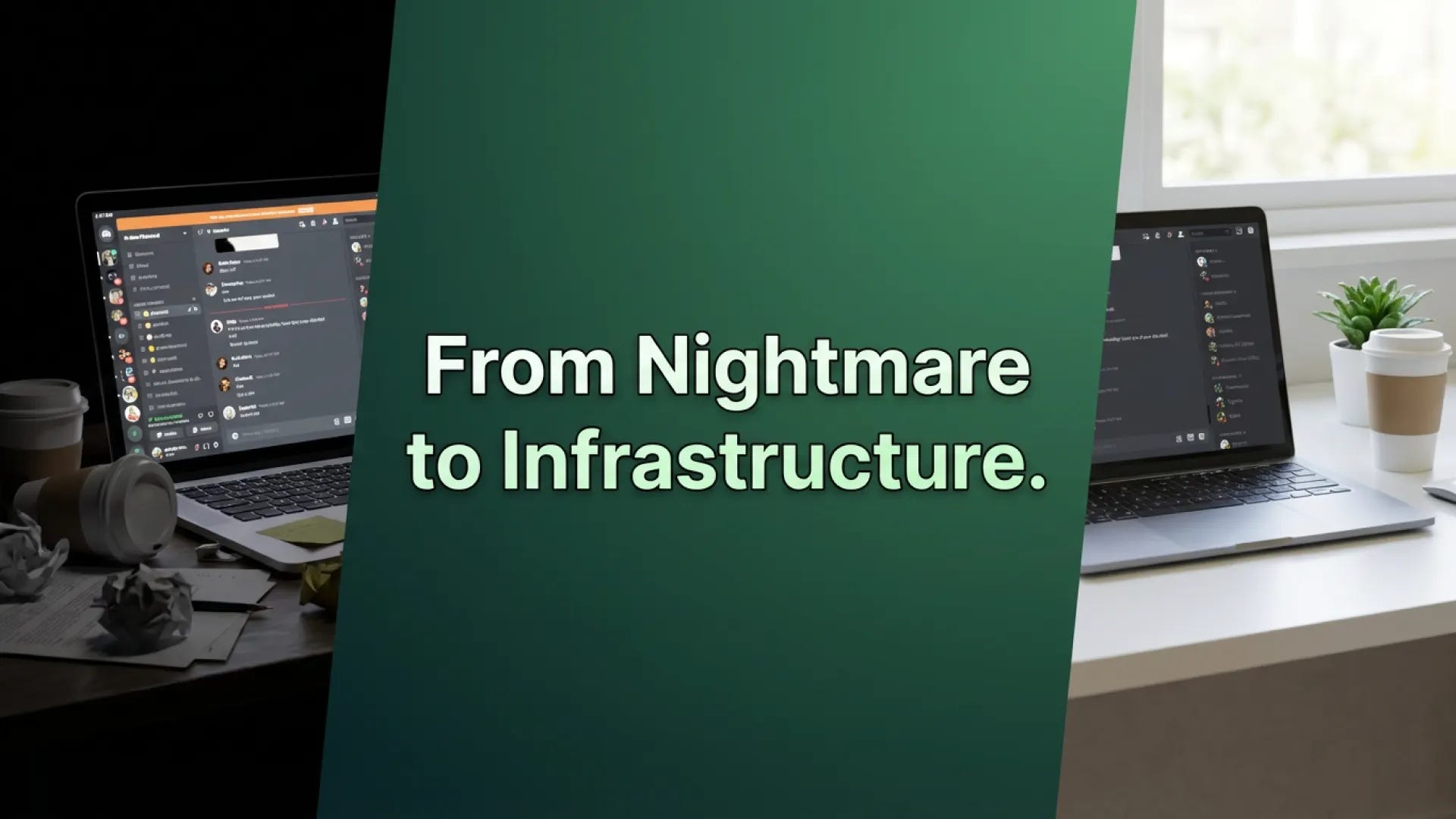
Twenty-three founders have told me they have PTSD from running their Discord communities in the past fourteen months.
Not burnout. Not stress. Post-traumatic stress disorder.
One couldn't sleep because she kept imagining member complaints accumulating while she was offline. Another avoided the app for three consecutive days because the notification badge triggered anxiety. A third watched her thriving community become toxic after hiring someone who couldn't manage basic moderation.
The pattern repeats with remarkable consistency. Excitement about community building gives way to overwhelm from daily management demands. You hire someone who promises expertise but creates new problems. Drama escalates beyond your control. Engagement collapses. The platform that was supposed to fuel growth becomes something you actively resent.
This resentment is completely justified.
The Source of Community Trauma
Most Discord community managers approach the platform like it's Twitter with additional channels. They focus on reacting to problems rather than preventing them. They don't understand Discord's unique psychology, its automation capabilities, or how to construct systems that function without constant human supervision.
This reactive approach works until your community reaches a few hundred active members. Then everything breaks simultaneously. Moderation falls behind. Important messages disappear in noise. New members get lost in poorly structured onboarding. Engaged members leave because the experience deteriorates.
The community manager you hired starts making excuses. They're overwhelmed. They need more tools. They need more moderators. They need more of your time explaining what should have been systematized from the beginning.
You're back where you started, except now you're paying someone and the community is worse.
Prevention Systems Over Reaction Loops
I've maintained engagement rates around fifteen percent in communities with over 1.7 million members. Industry standard sits closer to one or two percent. The gap isn't talent or effort. It's systematic prevention versus reactive management.
Prevention systems address problems before members experience them. New member onboarding happens through structured automation that provides context without overwhelming people. Channel architecture prevents confusion by making purpose immediately clear. Moderation operates on documented frameworks rather than individual judgment calls. Content distribution follows patterns that maintain visibility for important information.
These systems reduce the daily decision load on community managers by roughly seventy percent. They also eliminate most of the drama that creates founder trauma.
When I build these systems for clients like HeyGen, BlueWillow, and RSVLTS, the transformation isn't subtle. Communities that generated daily stress become infrastructure that operates predictably. Founders who avoided Discord start seeing it as a strategic asset. Revenue attribution to community becomes measurable rather than speculative.
Healing Community Trauma
If you're carrying Discord trauma, removing it requires replacing the systems that created it.
You can't heal by trying harder with the same broken approach. You can't fix it by hiring another generalist community manager who treats Discord like every other social platform. You need someone who understands that running a serious community is a full-time job requiring sophisticated infrastructure.
The platform that became your nightmare can become your strongest growth channel. But only if you stop treating it like a simple communication tool and start building it like strategic revenue infrastructure.
You shouldn't dread opening Discord. You should expect it to work without needing you.
Mr. Ashraful specializes in transforming Discord communities from sources of founder stress into strategic business infrastructure. His systems have supported communities managing millions in revenue across SaaS, AI, and eCommerce.
<<<<<<< HEAD