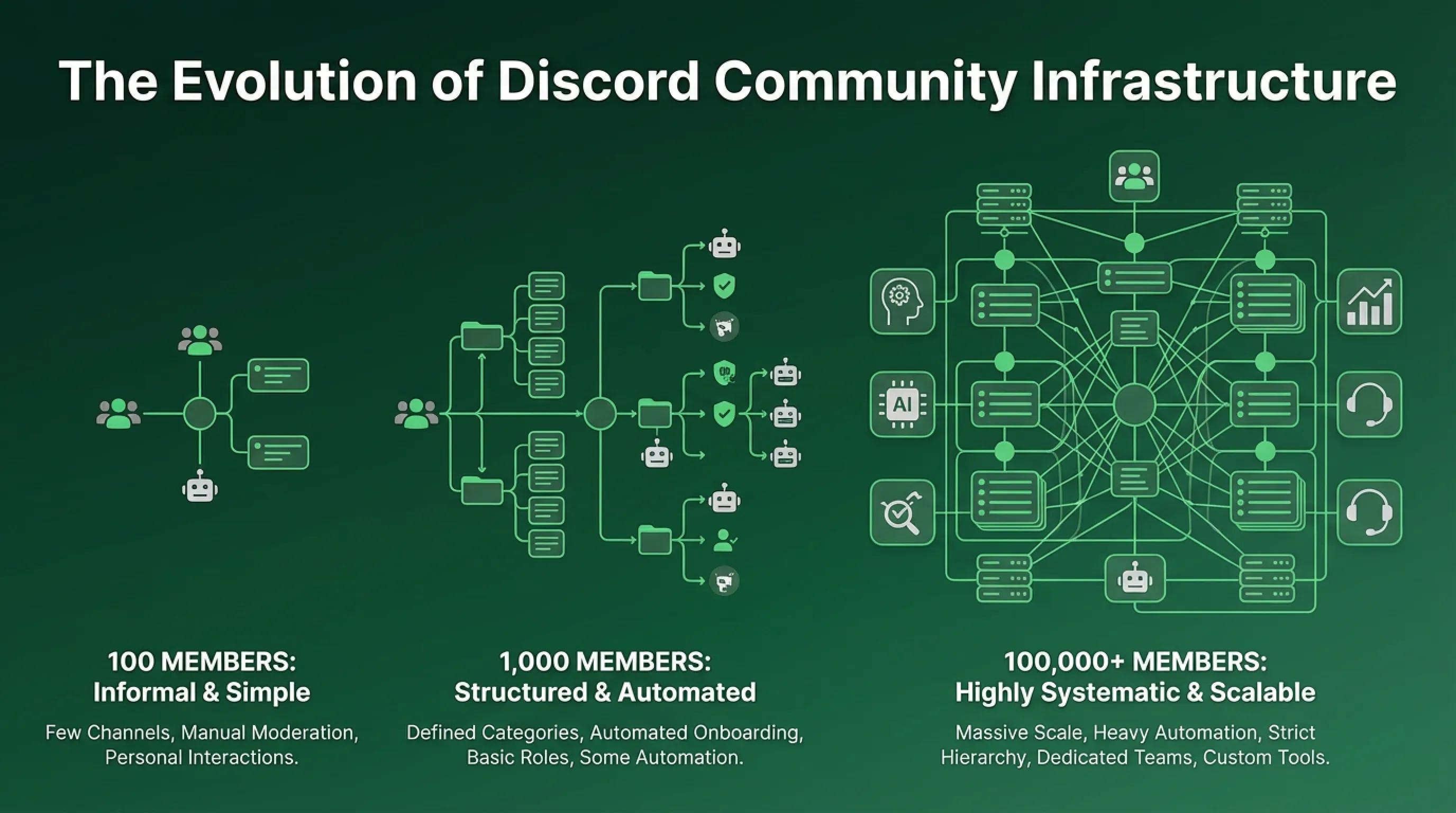
A founder called me when his Discord hit 10,000 members.
"Everything's broken," he said.
Moderation was chaos. Support was underwater. The community culture had become toxic. Active members were leaving.
Six months earlier, at 2,000 members, everything worked smoothly.
What changed?
He was trying to run a 10,000 member community with 2,000 member systems.
It failed exactly as it always fails.
The Scale Illusion
When communities grow, founders assume growth means more.
More members. More conversations. More activity.
Same systems. Just bigger.
This is completely wrong.
Community scale isn't linear. It's transformational.
The community at 10,000 members isn't a larger version of the community at 1,000. It's a different type of organization entirely.
Requiring different structure. Different systems. Different management approaches.
Founders who don't understand this hit a wall. Growth stalls. Quality degrades. Eventually, the community collapses or plateaus permanently.
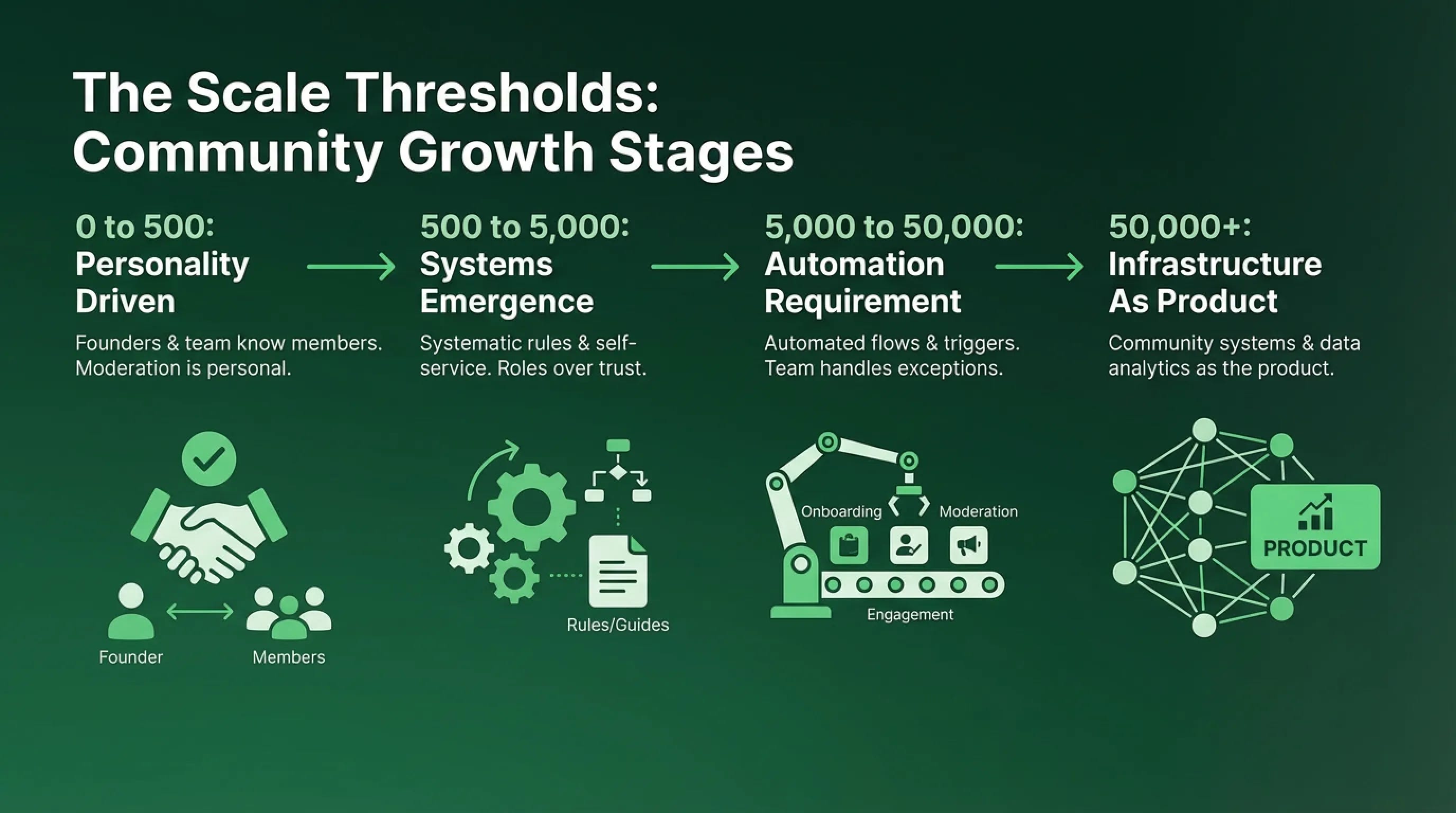
The Scale Thresholds
Based on managing communities from hundreds to over a million members, clear thresholds emerge.
0 to 500: Personality Driven
At this scale, communities run on founder and team personality.
Founders can be present in most conversations. Team members know regular members by name. Moderation is judgment based. Support is personal.
This works beautifully.
Members feel connected to leadership. Community culture develops organically. Problems get solved through relationships.
Founders love this scale. It feels manageable and authentic.
But it's temporary.
500 to 5,000: Systems Emergence
Somewhere in this range, personality driven management stops working.
Founders can't be in every conversation. Team members don't know everyone. Manual moderation misses things. Personal support creates bottlenecks.
This is the first transformation moment.
Communities that successfully navigate this threshold implement:
Systematic moderation rules instead of case by case judgment.
Self service support resources instead of answering every question manually.
Role based permissions instead of trusting everyone.
Clear processes instead of informal coordination.
Founders who resist this transformation get stuck. Their community caps at a few thousand members because systems can't support more.
5,000 to 50,000: Automation Requirement
Above 5,000 members, manual processes become completely impossible.
You cannot manually moderate a community this size. You cannot manually onboard members. You cannot manually create engagement.
Physically impossible. Not enough hours.
Communities that reach this scale rely heavily on automation:
Automated moderation for common violations.
Automated onboarding flows.
Automated role assignment.
Automated engagement triggers.
Human team members become exception handlers and strategic decision makers, not daily operators.
50,000+: Infrastructure As Product
At very large scale, the community infrastructure itself becomes as important as community purpose.
Members experience the community through systems. Those systems determine their experience more than human interaction does.
Communities at this scale invest heavily in:
Custom bot development.
Sophisticated automation workflows.
Data analytics for community health.
Systematic culture reinforcement.
The community becomes a product that happens to involve humans, rather than a human gathering that uses tools.
Graphic Suggestion: A clear chart or diagram showing these four threshold levels with key characteristics, required systems, and transformation points marked. Make it immediately clear where different communities sit and what transitions they face.
What Actually Breaks At Each Stage
The failure modes are predictable.
Moderation Collapse
Small communities use contextual judgment. Moderators evaluate situations individually.
This stops working around 2,000 active members.
Beyond that point, moderators can't see everything. Violations slip through. Inconsistency creates resentment. Toxic behavior spreads.
The solution isn't more moderators. It's systematic rules that execute automatically.
Support Overwhelm
Small communities answer questions personally.
Beyond a few thousand members, this becomes impossible. Question volume exceeds team capacity.
Response times stretch. Member frustration grows. Support team burns out.
The solution isn't more support people. It's self service infrastructure where answers are findable without asking.
Culture Drift
Small communities develop culture organically through founder presence and example.
Large communities lose founder presence. New members outnumber old members. Original culture dilutes.
Without intentional culture architecture, large communities default to lowest common denominator behavior. Usually toxic.
The solution isn't trying to be everywhere. It's systematically reinforcing desired culture through structure, automation, and incentives.
Engagement Disappearance
Small communities maintain engagement through personal connection.
Large communities are too big for personal connection at scale.
Members become anonymous. They stop participating. Engagement drops despite growing membership.
The solution isn't manual engagement efforts. It's systems that create engagement opportunities algorithmically.
The Founder's Dilemma
Most founders resist these transformations emotionally.
They built their community through personal connection. They love the intimate feel of small scale. They fear losing authenticity.
So they try to preserve small community dynamics while scaling.
They try to personally welcome every new member. They try to be present in every channel. They try to moderate based on context and judgment.
This creates three outcomes:
First, founder burnout. You can't be everywhere. Trying anyway destroys you.
Second, quality degradation. You can't maintain quality manually at scale. Things slip through.
Third, growth caps. Systems that can't scale prevent community from scaling.
The founders who successfully scale accept a hard truth: the 50,000 member community won't feel like the 500 member community.
It will feel different. Because it is different.
That's okay.
Different doesn't mean worse. It means appropriate for scale.
What Large Scale Communities Actually Optimize
Servers managing hundreds of thousands of members think differently.
They don't optimize for intimacy. They optimize for consistent quality experience at scale.
They don't preserve founder personality. They build systems that reflect founder values.
They don't try to know every member. They create infrastructure where every member can find value.
This approach feels cold to founders used to small scale.
But it works.
Members of large communities don't expect personal relationships with founders. They expect functional, valuable, well run communities.
Deliver that through systems, and you create sustainable scale.
The Infrastructure Investment Required
Scaling requires investing in infrastructure that seems excessive at your current size.
This is the paradox: you need to build systems for your target scale before you reach it.
Building at 5,000 members for 50,000 capacity feels wasteful. But if you wait until you have 50,000 members to build that capacity, you'll never reach 50,000 members.
Because growth accelerates. Going from 5,000 to 50,000 happens faster than going from 500 to 5,000.
If you're not prepared systemically, rapid growth destroys community quality. Quality degradation stops growth.
Successful scaling means building ahead of your curve.
Investing in automation before you absolutely need it.
Developing systems for problems you don't quite have yet.
Creating capacity before demand forces it.
This requires capital and conviction. Most communities don't do it.
That's why most communities cap below 10,000 members despite market opportunity for more.
What This Means For Your Community
If you're building a Discord community as business infrastructure, you face a choice.
You can optimize for current scale. Build systems that work perfectly for your size right now. Stay comfortable.
This is fine if you don't plan to grow.
But if growth is part of your business model, current scale optimization guarantees future pain.
Better approach: identify your target scale. Build systems appropriate for that scale. Accept short term over engineering.
Because over engineering at 1,000 members becomes right engineering at 10,000 members.
And reaching 10,000 members with systems that work is better than reaching 10,000 members with systems that break.
<<<<<<< HEAD
Build Discord infrastructure for the scale you're growing into, not the scale you're comfortable with → ashraful.systems