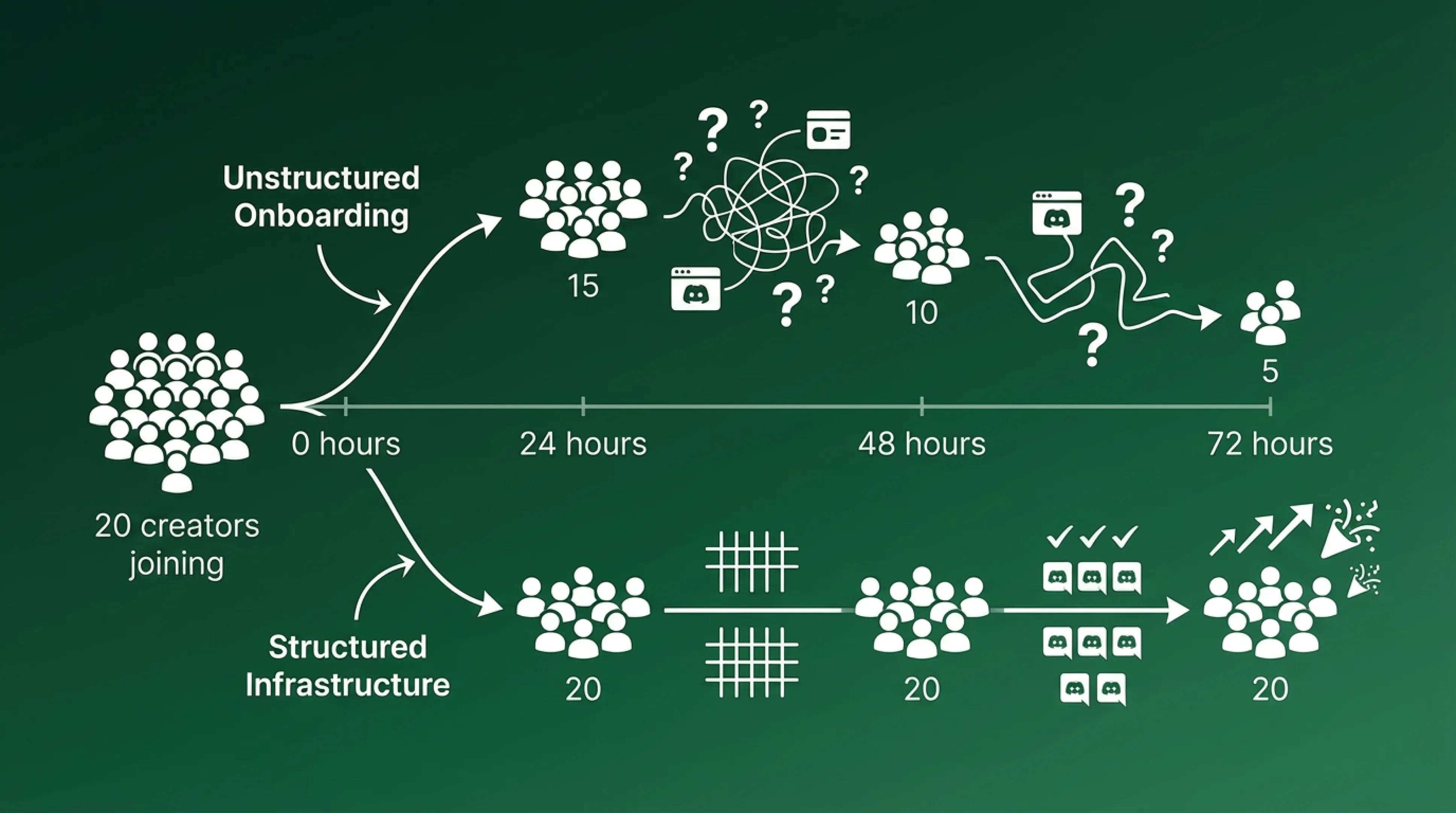
Your TikTok shop agency lands a new brand partnership. The contract is signed. Commission structures are finalized. Now you need creators to drive sales.
You spin up a Discord server. Channels get created with standard names: general, announcements, questions, links. Roles are configured for different creator tiers. Invite links go out to your network.
Creators start joining. The server populates. Everything looks active.
Then 48 hours pass.
Half the creators who joined have already gone silent. They're still in the server technically, but they're not engaging. They're not asking questions. They're not in the networking channels. They're ghosts.
This pattern repeats across TikTok shop agencies managing Discord communities. The assumption is that creators lack motivation or weren't serious. But that's rarely the actual problem.
The real issue is what creators experienced in their first 48 hours.
The First Login Determines Everything
When a creator joins your Discord server, they're evaluating whether this partnership is worth their time. That evaluation happens fast. Within minutes of logging in, they're forming conclusions about organization, professionalism, and whether they'll get the support they need to succeed.
Most agency-run Discord servers fail this evaluation immediately.
Creators land in a server with dozens of channels but no clear starting point. There's no welcome message explaining what to do first. The channel names are generic. There's no obvious place to find brand guidelines, product information, or commission details. Questions they have about the partnership go unanswered because there's no visible support system.
So they browse for a few minutes, don't find what they need, and mentally check out. They might stay in the server, but they've already decided this isn't a priority. You've lost them before they created a single piece of content.
This isn't a creator quality problem. It's an infrastructure problem.
What Structured Onboarding Actually Looks Like
Agencies that retain creators build onboarding infrastructure before sending invite links. They don't guess at channel organization. They design systems that remove friction from the first interaction.
Structured onboarding includes:
Custom welcome sequences. When creators join, they receive an automated message that explains exactly what to do first. Not generic Discord bot text. A message specific to this brand partnership that walks them through verification, where to find resources, and how to get support.
Knowledge base channels. A dedicated space with pinned messages containing brand guidelines, product catalogs, commission structures, content examples, and FAQs. Creators don't have to ask basic questions because the answers are already visible and organized.
Verification systems. Not every person who joins your server is a serious creator. Verification filters out casual browsers and ensures only committed partners get access to the main channels. This keeps the community focused and reduces noise.
Visible support systems. Support ticket channels where creators can ask questions and get responses from agency team members. This isn't a general questions channel where messages get buried. It's a structured system that tracks requests and ensures nothing falls through.
Networking spaces. Channels where creators can share wins, troubleshoot challenges, and build relationships with others in the program. This peer support often matters more than agency support for retention.
Engagement infrastructure. Challenges, recognition systems, and events that keep momentum going past the first week. Creators who see active engagement from both the agency and other creators are more likely to stay committed.
None of this requires expensive tools. It requires understanding Discord as business infrastructure rather than as a chat application.
The Multi-Brand Server Problem
Some agencies try consolidating all their brand clients into a single Discord server. The logic makes sense: easier to manage one community than five separate servers.
This can work if the infrastructure accounts for segmentation. Role-based access ensures creators only see channels relevant to the brands they're promoting. Automation handles brand-specific welcome messages and resources. Support tickets route to the appropriate agency team members based on which brand is involved.
But most multi-brand servers don't set this up properly. They create one general space with minimal separation between brands. Creators get confused about which guidelines apply to which brand. Resources get mixed up. Support becomes messy because nobody knows which team should handle which request.
The result is the same as an unstructured single-brand server: creators disengage because the friction isn't worth it.
Why 48 Hours Matter
The first 48 hours are critical because that's when creators are most motivated. They just joined a new partnership. They're ready to create content and start earning commissions. Their attention is focused on your server.
If that initial energy meets friction instead of structure, they redirect their focus elsewhere. They have other partnerships, other opportunities, other platforms demanding attention. Your Discord server becomes background noise.
By the time you notice the disengagement and try to fix it, the momentum is gone. You can't recover that first impression. You can't recreate that initial motivation.
The only solution is building the infrastructure before creators join.
What This Looks Like in Practice
Agencies that understand Discord infrastructure don't launch servers until the systems are ready. They map out the creator journey from first login to first sale. They script the automated messages. They organize channels by function. They set up verification flows. They create the knowledge base content. They configure support ticket systems. They plan the first engagement event.
This takes time upfront. But it eliminates the ongoing problem of creator churn. Instead of constantly recruiting new creators to replace the ones who went silent, retention stays high because the experience is smooth from day one.
The agencies running successful TikTok shop Discord communities aren't just managing chat channels. They're operating business infrastructure that directly impacts creator retention and sales performance.
The Real Cost of Poor Onboarding
When creators disengage in the first 48 hours, agencies lose more than just potential sales volume. They lose the time invested in recruiting those creators. They lose the network effects that come from having an engaged community. They lose credibility with brand clients who see low creator participation and question whether the agency can actually deliver.
Fixing this doesn't require more creator outreach. It requires fixing what creators see when they arrive.
If your TikTok shop agency is losing creators in the first 48 hours, the problem isn't your pitch. It's your infrastructure.
Mr. Ashraful specializes in systems-based Discord community management for companies where community drives revenue.
<<<<<<< HEADIf your agency needs structured Discord infrastructure that retains creators and supports growth, visit → ashraful.systems.