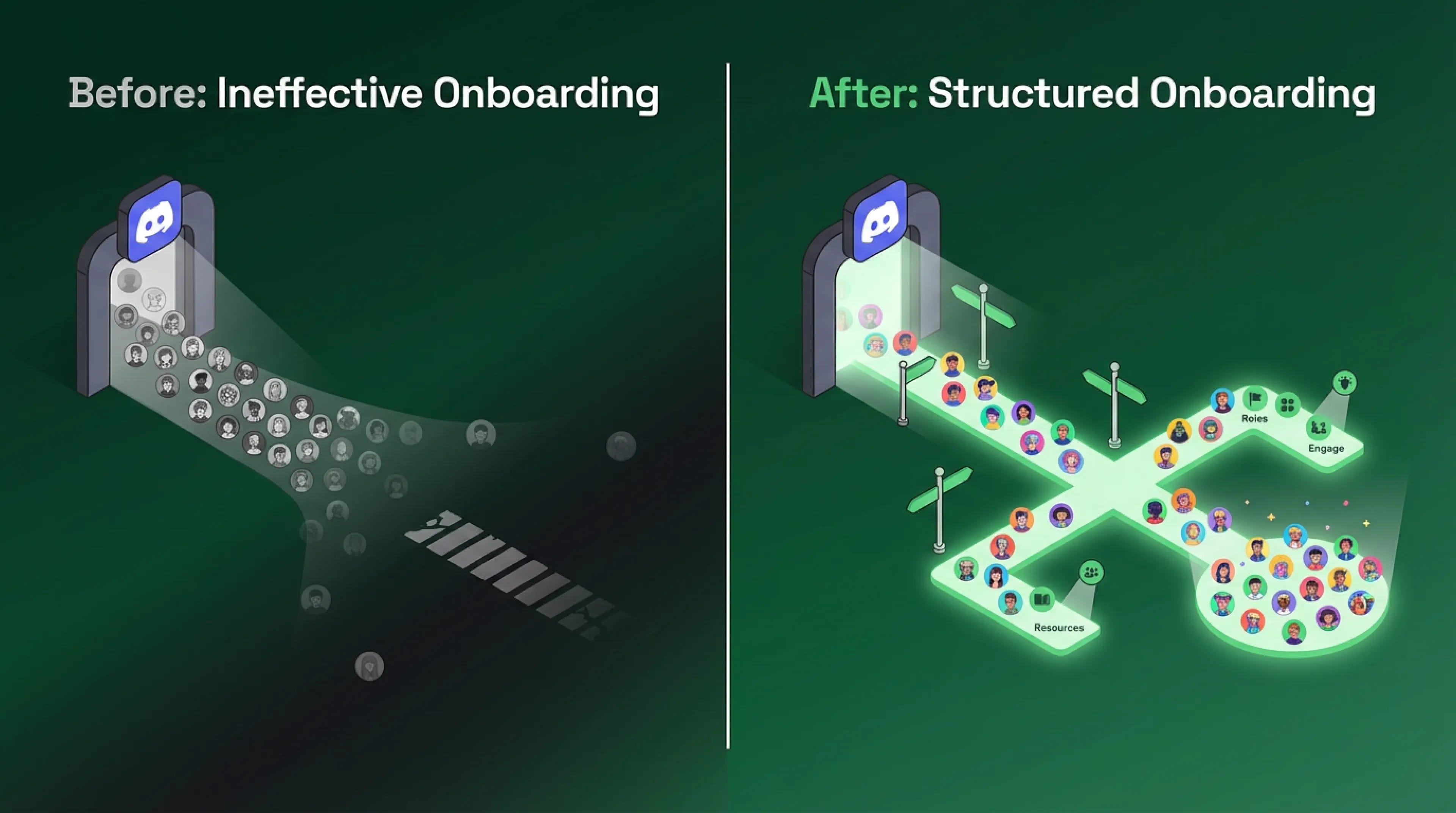
A CEO showed me his Discord analytics last month.
"We're getting great acquisition," he said. "Hundreds of new members monthly. But engagement isn't growing. I don't understand."
I looked at the retention data.
Of members who joined in the past 30 days, only 28% had posted even once. The rest never engaged.
His community didn't have an acquisition problem.
It had an onboarding problem.
The First 72 Hours
Most executive teams focus on getting people in the door. They optimize marketing. They refine messaging. They reduce friction in the join process.
All important work.
But they stop there.
They assume: once someone joins, they'll figure out the community organically.
This assumption destroys community economics.
Because new members don't orient themselves naturally. They need guided onboarding. Without it, they bounce.
The data is consistent across communities I've managed:
Members who engage within 72 hours of joining have a 65% chance of remaining active long term.
Members who don't engage in those first 72 hours have less than 15% chance of ever engaging.
The first three days aren't just important. They're deterministic.
What New Members Actually Experience
When a new member joins your Discord, you know what's happening. You've built the server. You understand the structure. You know where value lives.
The new member knows none of this.
Their experience:
Click join link. Server appears in their Discord sidebar. They click to explore.
A list of channels appears. Maybe a dozen. Maybe many more. Each with a name that means something to you and nothing to them.
No guidance on where to start. No explanation of what each channel contains. No welcome message telling them what to do next.
So they browse.
They click through channels randomly. See conversations without context. Feel like an outsider looking in. Wonder if they're supposed to be here.
After five or ten minutes of this, they close Discord.
They might return the next day. Probably the same experience. Maybe they post something tentatively in a channel that seems appropriate. Maybe not.
By day three, they've mentally categorized your server as "that thing I joined once but never really figured out."
They stop checking.
You lost them.
Not because they weren't interested. Because you made being interested too hard.
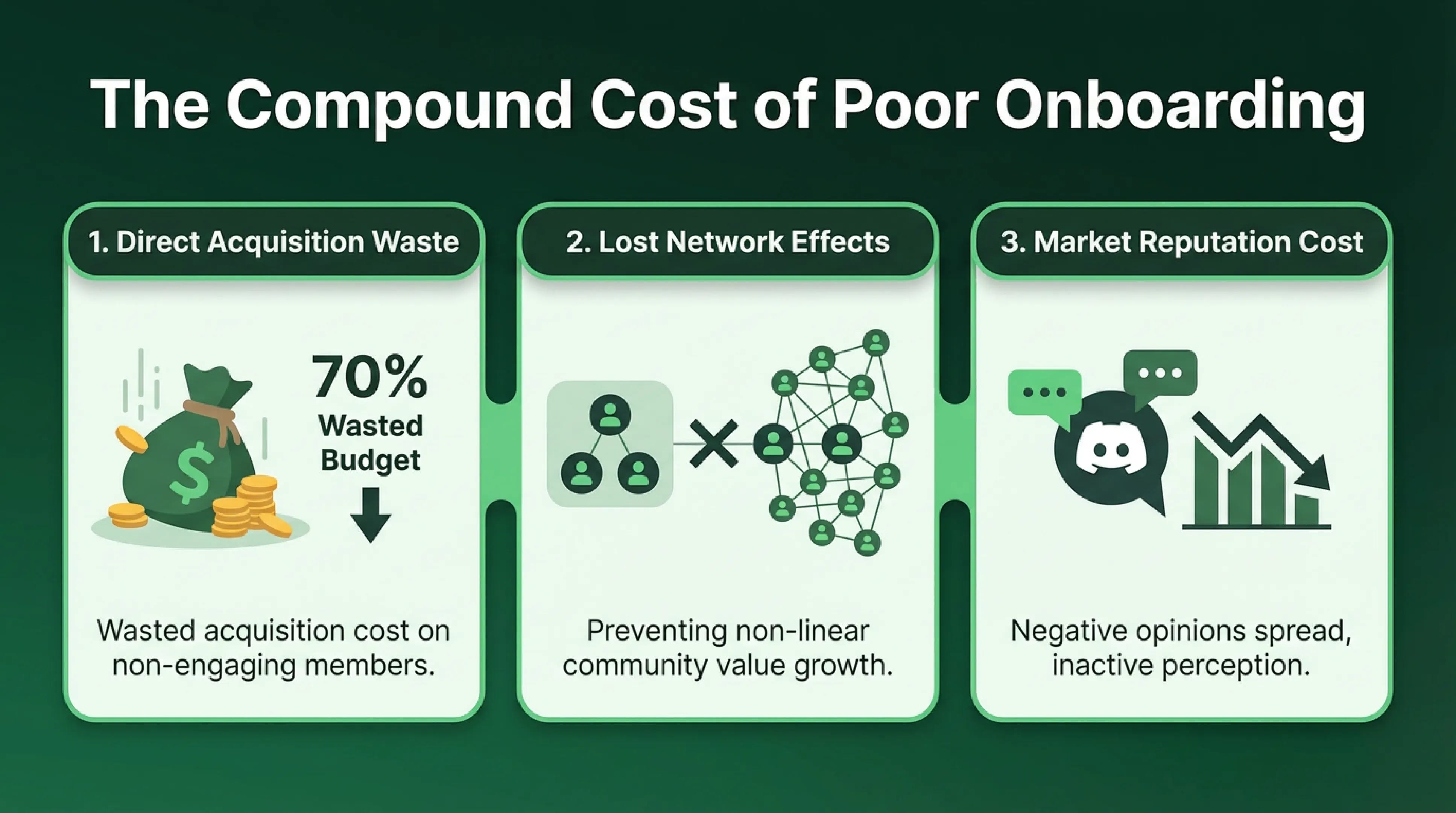
The Compound Cost
This failure pattern creates expensive problems.
Direct Waste
Every lost member represents wasted acquisition cost. Whether you acquired them through ads, content marketing, partnerships, or organic growth, there was a cost.
If 70% of acquired members never engage, you're wasting 70% of acquisition budget.
Opportunity Cost
Members who bounce early don't just fail to engage. They prevent network effects from compounding.
Community value grows non linearly with active membership. Every lost member reduces the potential value for remaining members.
Reputation Cost
People who join communities and bounce develop opinions. Those opinions spread.
"I joined that Discord but it wasn't very active" becomes market reputation. Even if your community is active, inactive members don't see that activity because they left before engaging.
What Actually Works
Communities that retain new members don't rely on organic orientation. They engineer specific onboarding experiences.
Immediate Personalized Contact
The moment a member joins, a private thread should open automatically.
Not a DM from a bot. A thread where a real person (or at minimum, a very well designed bot that feels personal) welcomes them specifically.
This thread serves multiple purposes:
Creates immediate human connection. The member isn't alone in a crowd. Someone acknowledged them.
Provides safe space for questions. Public channels feel risky for new members. Private threads remove that friction.
Establishes server value immediately. The welcome message should clearly state what the member gets from being here.
One company I worked with implemented automated private thread welcomes. Within a month, their three day retention improved from 32% to 68%.
Same community. Different first impression.
Single Clear Next Step
Decision paralysis kills engagement.
When new members see everything at once, they choose nothing.
Effective onboarding reveals community progressively.
Day one: Member sees welcome channel and one activity channel. That's it.
Clear instruction: introduce yourself in the welcome channel.
They complete that step. Two more channels unlock.
This approach feels restrictive to some teams. The concern: we're limiting access.
But compare outcomes:
Unlimited access from day one: 30% engagement rate.
Progressive unlock onboarding: 70% engagement rate.
The goal isn't maximum access. It's maximum engagement.
Achievement Structure
Onboarding shouldn't feel like homework. It should feel like progress.
Frame each step as an achievement:
"Complete your introduction" becomes "Introduce yourself and unlock the resource library."
"Read the community guidelines" becomes "Learn how we keep this community valuable and earn the Active Member role."
Small psychological shift. Significant behavioral impact.
People want to complete things that feel like achievement. They resist things that feel like requirements.
Time Bound Intensity
The first 72 hours get intensive attention. After that, members integrate into normal community rhythm.
This means:
Day one: Private welcome thread, clear first task, completion confirmation.
Day two: Check in message if they haven't completed first task, or encouragement message if they have.
Day three: Final touch point. If engaged, welcome to full community. If not, last attempt to create engagement.
After 72 hours, automated intensive onboarding ends. Members either integrated into the community or they didn't.
This intensity is sustainable because it's temporary. You can't maintain this touch level forever. You don't need to. The 72 hour window is when impact is highest.
The Technical Setup
This onboarding approach requires infrastructure.
You need systems that:
Create private threads automatically when members join.
Manage progressive channel unlocks based on completion criteria.
Track onboarding progress per member.
Trigger messages at appropriate time intervals.
Some of this can be built with existing Discord bots. Some requires custom development.
The investment is worth it.
Because the alternative is continuing to waste acquisition budget on members who never engage.
What This Looks Like In Practice
User joins server.
Private thread opens immediately. Message appears:
"Welcome to [Community Name]. I'm [Name], and I help new members get oriented. You joined because [clear value statement]. Here's what happens next: introduce yourself in the welcome channel. Once you do, I'll unlock access to our resource library and main discussion channels. Looking forward to having you here."
User completes introduction.
Two things happen: more channels unlock, and a response appears in their private thread acknowledging completion and explaining what they now have access to.
User explores newly available channels.
They're not overwhelmed because it's still a limited set. But they're not restricted because they have access to real value.
Day two check in appears in private thread.
"Saw you introduced yourself yesterday. Have you had a chance to explore the resource library? Curious what you think of [specific resource relevant to their introduction]."
User engages or doesn't. If they do, they're likely retained. If they don't, one more touch point on day three.
By end of 72 hours, user is either integrated into community or has received every reasonable attempt at engagement.
Retention rate: 70% plus.
The Audit You Should Run Today
If you operate a Discord community, check your retention data.
Of members who joined in the past 30 days, what percentage engaged within 72 hours?
If it's below 50%, you have an onboarding problem.
Good news: onboarding is fixable.
You don't need better marketing. You don't need different target audience. You don't need more content.
You need better first 72 hours.
Build that, and your community economics change immediately.
Because acquisition becomes efficient. Every member you bring in actually becomes a member.
That's when community stops being a cost center and starts being leverage.
<<<<<<< HEAD
Stop losing 70% of new members in the first three days. Learn how to build onboarding that actually retains → ashraful.systems