Your support team is drowning in repetition.
Not because they're slow, but because every new creator asks the same questions the last hundred creators asked. Your team answers "How do I submit content for review?" for the fortieth time this month. They explain commission structure again. They clarify posting guidelines to someone who joined yesterday, then again to someone who joined an hour ago.
This isn't a support problem. It's an infrastructure problem.
The Repetition Trap
Most TikTok shop agency Discord servers operate in permanent reactive mode. Creators join, questions arise, humans respond. The next day brings new creators and identical questions. Your support team's knowledge exists only in their heads and in scattered messages across a dozen channels.
There's no central resource. No comprehensive guide. No documentation that creators can reference before asking.
So they ask. And ask. And ask.
Your support team isn't solving complex problems. They're functioning as a human search engine, retrieving the same basic information repeatedly.
When you're managing 50 creators, this feels sustainable. When you reach 500, it becomes impossible.
What Proper Documentation Infrastructure Looks Like
Agencies successfully managing 500+ creators build knowledge bases before those creators arrive.
Not after support burnout forces their hand. Before.
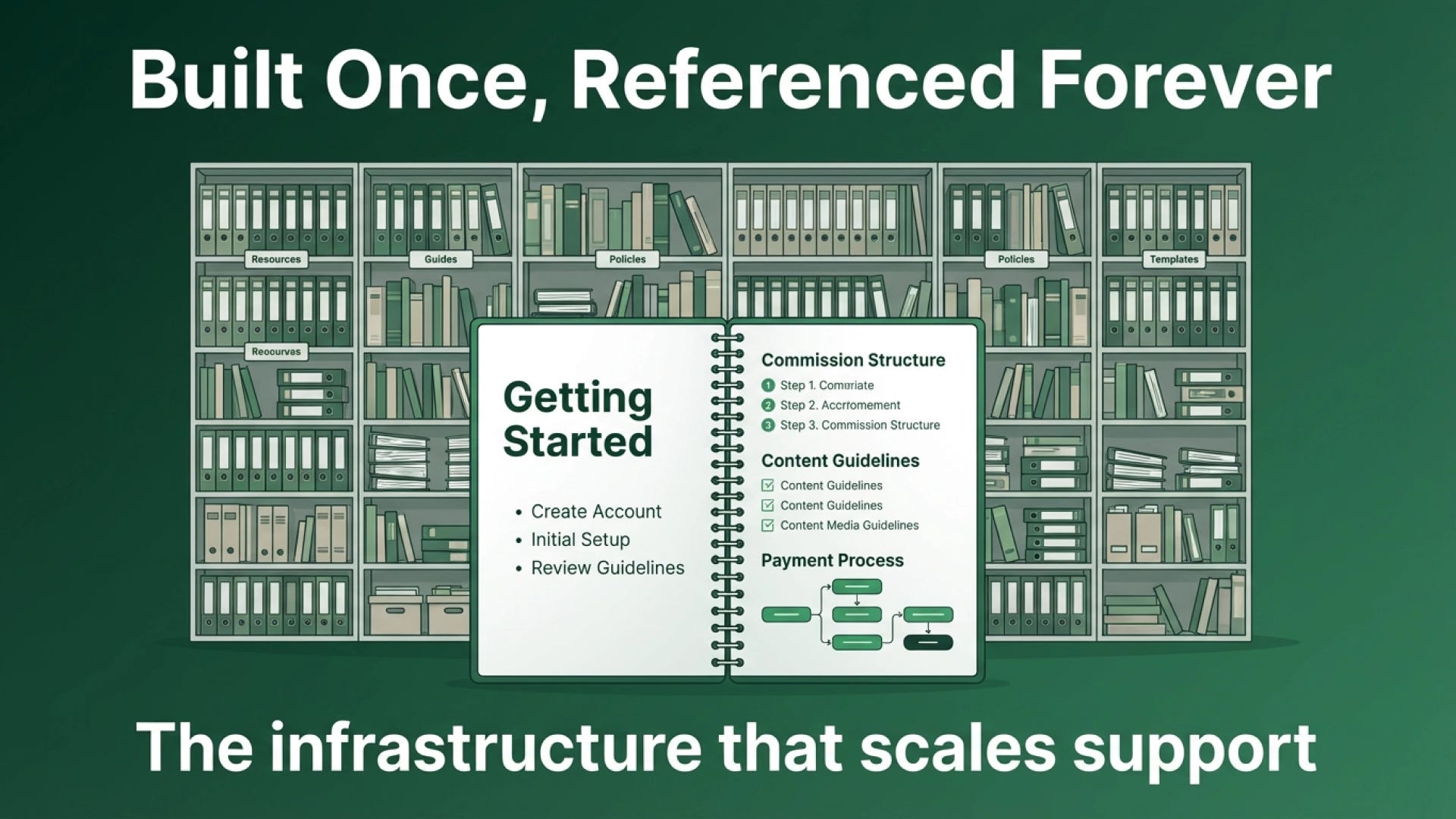
They document everything. Onboarding procedures with step-by-step instructions. Commission structure with examples and edge cases. Content requirements with visual examples. Posting schedules with timezone conversions. Approval processes with expected timelines. Payment procedures with common questions addressed.
They build FAQ sections that actually answer frequent questions instead of generic placeholders. They create troubleshooting guides for common technical issues. They establish clear escalation paths for situations requiring human judgment.
When creators join the server, they're directed to this documentation immediately. Not as barrier or punishment, but as empowerment.
Most questions disappear before reaching your support team.
The Questions That Remain
Here's what happens when you build proper documentation infrastructure.
The repetitive questions vanish. "How do I submit content?" is answered in the knowledge base. "When do I get paid?" is covered in the payment section. "What are the posting requirements?" is detailed in the content guidelines.
The questions that do reach your support team are different. They're specific to individual situations. They involve edge cases your documentation hasn't covered yet. They require human judgment about complex circumstances.
These are questions worth answering with human attention.
Your support team stops being reactive responders and becomes strategic resources. They're not explaining basic information for the hundredth time. They're solving actual problems, handling exceptions, and improving systems.
And when they encounter a new question multiple times, they don't just answer it repeatedly. They add it to the documentation.
The Compound Effect
Documentation infrastructure compounds.
Every question you document once is a question your support team never has to answer repeatedly. Every guide you build serves the next thousand creators, not just the next ten.
When your 500th creator joins, they receive the same quality information as your first. Not because your team answered the same question 500 times with identical patience, but because you built systems that preserve and distribute knowledge.
Your support quality actually increases as you scale, rather than degrading under volume.
The Build Timing Question
Most agencies wait too long.
They build knowledge bases after their support team is already overwhelmed. After repetition has created burnout. After creator frustration has damaged retention.
The agencies scaling successfully build documentation infrastructure early. When they're managing 50 creators and answers still feel fresh, they're documenting everything. When support is manageable, they're creating the systems that will keep it manageable at 500.
If your support team is answering identical questions daily, you don't need more support people. You need documentation infrastructure that prevents those questions from requiring human response.
Knowledge bases don't replace support teams. They multiply their effectiveness.
And they transform support from unsustainable repetition into strategic resource.
Every question answered repeatedly is infrastructure you haven't built yet.
<<<<<<< HEAD