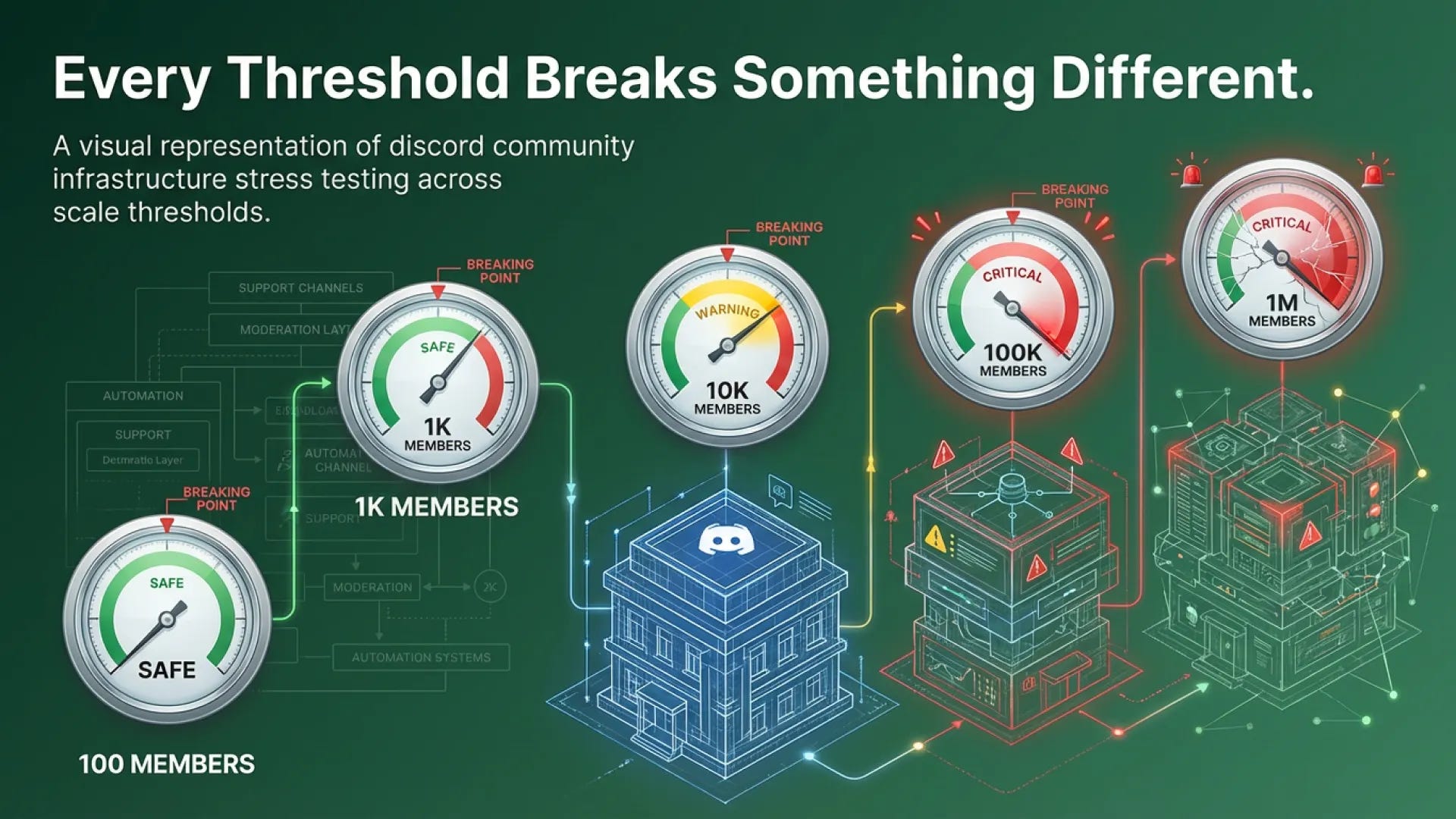
There's a lesson you only learn by breaking things at scale.
When I started managing Discord communities, I thought scaling was straightforward. Get more members, add more moderators, maybe create some extra channels. Keep doing what's working, just do more of it.
Then I hit the first breaking point. Systems that worked perfectly at 500 members became completely unusable at 5,000. I learned that scaling isn't linear. It's threshold-based. You hit specific member counts where your entire infrastructure must fundamentally change or it collapses.
After managing communities that grew from thousands to over a million members, I can tell you exactly where these breaking points are and what fails at each one.
The 100-member threshold: Personal relationships end
Below 100 members, you can know everyone. You recognize names. You remember conversations. Support happens through direct personal interaction. Moderation is based on knowing people and using judgment.
This feels great. It's the ideal community experience. Personal, connected, responsive.
Then you cross 100 active members and you can't maintain personal awareness anymore. Names blur together. You forget who asked what. New members join faster than you can welcome them personally.
The infrastructure that breaks: personal memory as a database, informal support processes, judgment-based moderation, founder-dependent operations.
What you need to build: systematic onboarding processes, documented support procedures, consistent moderation standards, role-based authority distribution.
Most communities try to maintain the personal approach past this point. They burn out trying to personally welcome everyone and remember every conversation. The founder becomes the bottleneck.
The 1,000-member threshold: Informal systems collapse
Between 100 and 1,000 members, you can still run on mostly informal processes with some documentation. Your team knows how things work. New team members learn by observing.
Once you cross 1,000 active members, informal knowledge transfer becomes impossible. Team members can't learn by observation because too much happens simultaneously. Questions that used to get asked once per day now appear every hour. Manual processes that took five minutes now take fifty.
The infrastructure that breaks: informal documentation, manual support processes, ad-hoc problem solving, observational training.
What you need to build: comprehensive documentation, automated routine tasks, formal escalation protocols, systematic training materials.
Communities that don't make this transition get stuck. They can't onboard new team members effectively. Every process depends on specific people who know the informal systems. Growth becomes impossible without those people working unsustainable hours.
The 10,000-member threshold: Human processing capacity maxes out
Between 1,000 and 10,000 members, you can still manually handle most processes with good documentation and some automation. Your team stays on top of questions. Issues get resolved within reasonable timeframes.
Once you cross 10,000 active members, human processing capacity hits absolute limits. The volume of routine questions exceeds what any reasonable team can answer manually. Channel activity moves faster than anyone can follow. Important issues get buried in noise.
The infrastructure that breaks: manual support responses, reactive moderation, single-channel discussions, manual role management.
What you need to build: extensive automation for routine tasks, proactive moderation systems, channel segmentation strategies, automated role assignment, ticket-based support systems.
This is the threshold where most communities either plateau or transform. Those that refuse to automate get overwhelmed. Those that automate poorly create corporate-feeling experiences. Those that automate strategically scale successfully.
The 100,000-member threshold: Architecture determines usability
Between 10,000 and 100,000 members, you're managing high volume but the community structure still feels like a large Discord server.
Once you cross 100,000 active members, information architecture becomes your primary challenge. Members can't find what they need. Channels move too fast to follow. Search becomes critical. Organization determines whether your community is usable or overwhelming.
The infrastructure that breaks: simple channel lists, basic role structures, manual content organization, reactive information distribution.
What you need to build: sophisticated channel categorization, advanced role hierarchies with granular permissions, automated content routing, proactive information architecture, comprehensive search optimization.
At this scale, you're not just managing conversations. You're managing information flow through a complex system. Design decisions about channel organization have massive impact on member experience.
The 1,000,000-member threshold: Platform-level infrastructure
Above 100,000 members, you're running a large community. Above 1,000,000 members, you're running infrastructure that resembles a platform.
At this scale, automated systems must handle 95%+ of routine interactions. Your team focuses exclusively on edge cases, escalations, and strategic decisions. Everything that can be systematized must be systematized.
The infrastructure that breaks: anything manual, any system depending on human judgment for routine tasks, any process that hasn't been fully documented and automated.
What you need to build: platform-level automation infrastructure, advanced analytics systems, predictive capacity planning, systematic process documentation at every level.
Very few Discord communities reach this scale, but the ones that do operate fundamentally differently from anything smaller.
The early building principle
The lesson from managing at these scales: build infrastructure before you need it.
When you have 500 members, start building the systems you'll need at 5,000. When you have 5,000, build for 50,000. This feels excessive. You're creating infrastructure that seems unnecessarily complex for your current size.
But this approach means you scale smoothly instead of constantly fighting fires. Your growth accelerates because you're not constantly rebuilding broken systems. Your team focuses on value creation instead of emergency repairs.
The servers that scale successfully don't wait until they're drowning to build better infrastructure. They systematize early, document obsessively, and automate strategically.
They know that every threshold will break something. So they build systems that can handle the next threshold before reaching it.
Scale reveals infrastructure gaps. Build for the threshold you're approaching, not the size you currently have.
<<<<<<< HEAD