Last Tuesday, a CEO told me his Discord community wasn’t working.
His team had spent six months building it. They had great content. Strong value proposition. Solid member acquisition strategy. But engagement was abysmal.
I joined as a test member.
The problem revealed itself in 45 seconds.
I landed in a server with 23 channels. No welcome message. No context. No direction. Just... channels. Lots of them.
I closed Discord and went back to work.
This company wasn’t unique. They were typical.
The 60 Second Window
Here’s what most executives miss: community building isn’t about the community you have in six months. It’s about the experience you create in 60 seconds.
Because that’s your window.
Sixty seconds to answer three questions every new member asks:
-
What is this place?
-
Where do I start?
-
Is anyone actually here?
Fail to answer these questions immediately, and your member is gone. Not gone in the sense that they leave the server. Gone in the sense that they mentally check out. They become a number in your member count but not a participant in your community.
The difference in business terms? Dead weight versus revenue driver.
What Actually Happens in Those 60 Seconds
I’ve managed servers with up to 1.7 million members. I’ve seen what works and what fails at every scale.
The failure pattern is consistent:
New member joins. Sees wall of channels. Experiences decision paralysis. Waits for something to happen. Nothing happens. They drift away.
The success pattern is equally consistent:
New member joins. Lands in focused welcome area. Receives immediate acknowledgment. Gets clear next step. Takes that step. Experiences early win. Builds momentum.
The difference isn’t subtle. It shows up in your metrics within 48 hours.
The Infrastructure of First Impressions
Communities that nail onboarding share three structural elements:
Single Point of Entry
You wouldn’t design a building with 23 front doors. Yet that’s exactly what most Discord communities do.
High performing communities use one entry point. New members land in one channel that serves one purpose: orientation.
No announcements mixed in. No ongoing conversations to follow. Just a clear explanation of what happens next.
This isn’t about being restrictive. It’s about being respectful of cognitive load.
Immediate Human Connection
Automation is necessary. Human connection is what matters.
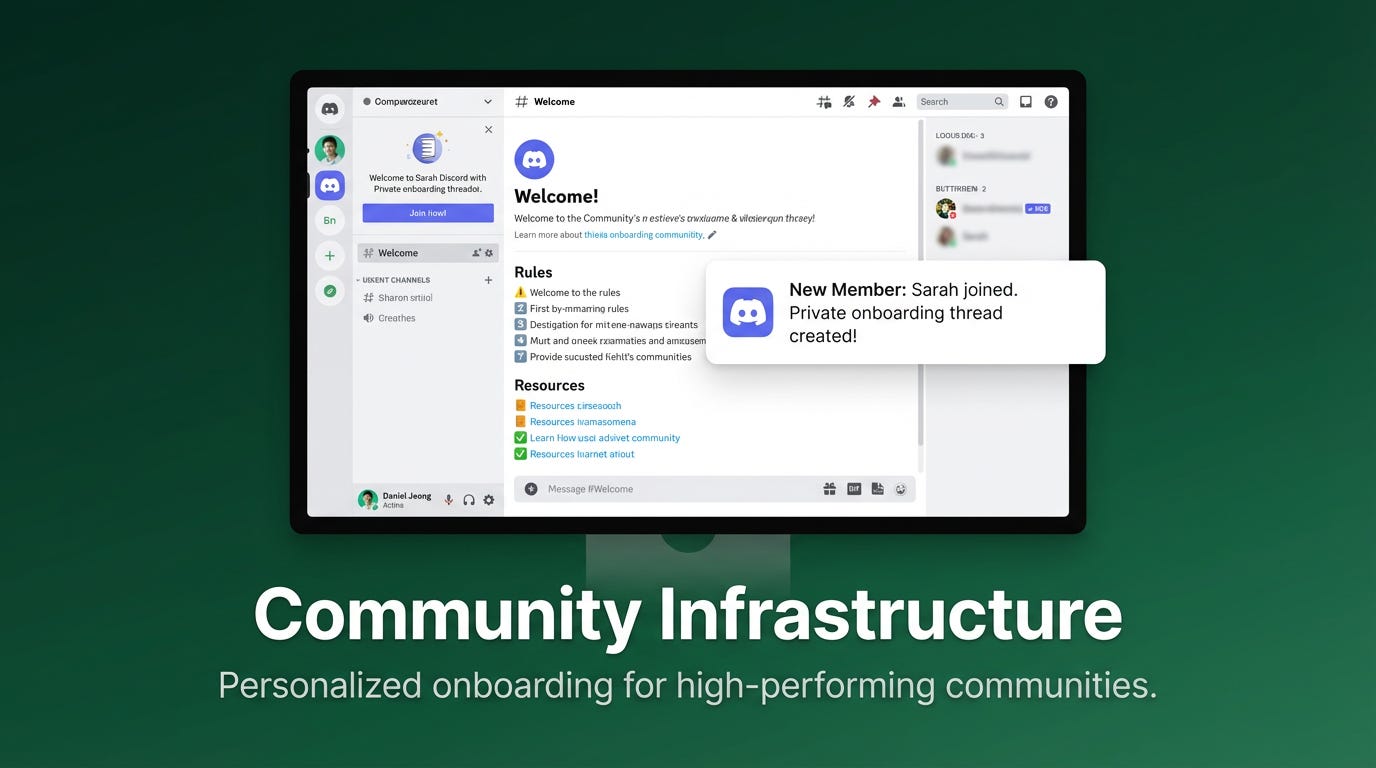
The communities that retain members long term use private threads for onboarding. Not as a manual process for every member (that doesn’t scale), but as an automated trigger that creates space for personal interaction.
When a new member joins, a private thread opens automatically. A team member or community manager introduces themselves. Not with a script. With actual human acknowledgment.
This changes everything.
Because now the community isn’t an abstract space with hundreds of strangers. It’s a place where someone knows your name.
Progressive Disclosure
Showing everything at once doesn’t prove value. It proves chaos.
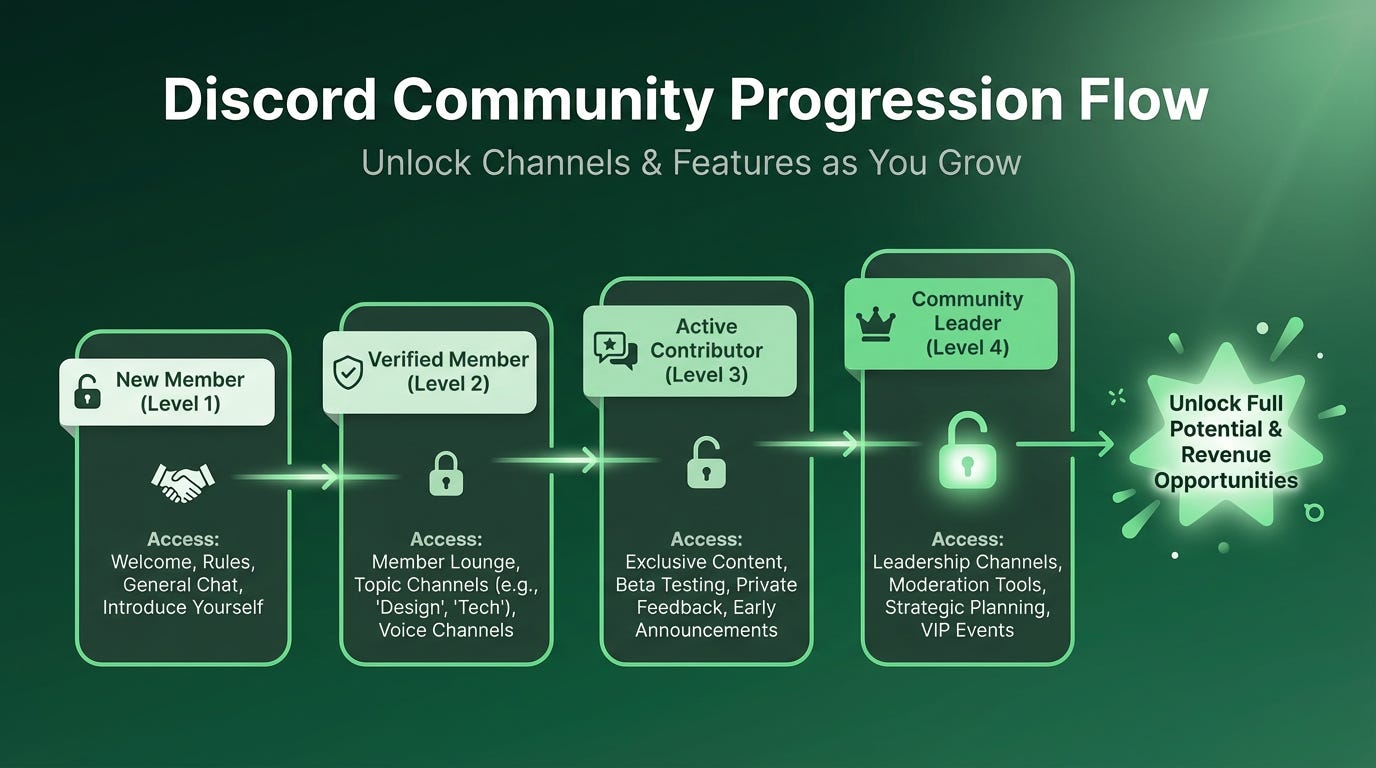
Smart communities reveal infrastructure progressively. New members see three channels initially. Complete onboarding step one, unlock two more channels. Complete step two, unlock additional areas.
This approach serves two purposes:
First, it prevents overwhelm. Second, it creates momentum. Each unlock feels like progress. Progress creates investment. Investment drives retention.
The Business Impact
These aren’t theoretical optimizations. They’re revenue decisions.
When members understand their environment immediately, they engage within their first session. First session engagement predicts long term retention. Long term retention determines community value.
The math is straightforward:
If you’re paying to acquire community members and losing them in 60 seconds, you’re burning money. If you’re keeping them engaged past that first minute, you’re building an asset.
For communities tied to products or services (which most executive driven communities are), this asset compounds. Engaged members become advocates. Advocates reduce acquisition costs. Lower acquisition costs improve unit economics.
Your Discord community isn’t a social experiment. It’s infrastructure.
What This Means For Your Team
If you’re running a company where community matters (and if Discord is part of your strategy, community matters), audit your first 60 seconds.
Join your own server as a new member. Experience what they experience. Ask yourself:
Can someone understand what this community is about within one minute? Is the next step obvious? Does anyone acknowledge new members immediately?
If the answer to any of these is no, you have a structural problem.
The good news: this is fixable. The systems that create great onboarding can be built in days, not months.
The better news: most of your competition hasn’t figured this out yet.
That window won’t stay open forever.
Ready to turn your Discord from a cost center into a revenue system? Let’s talk about what proper community infrastructure looks like for your business
<<<<<<< HEAD