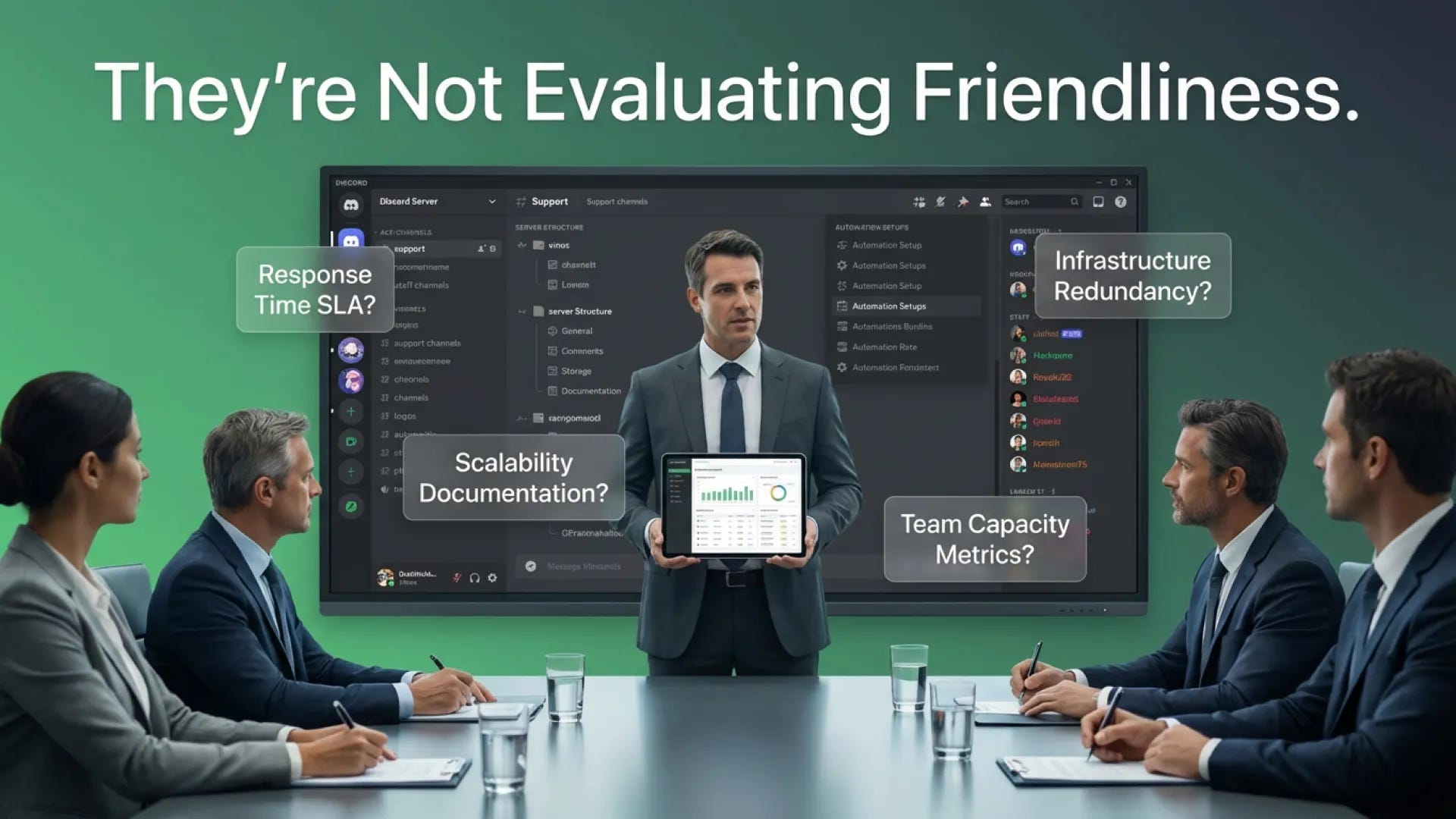
When an executive joins your Discord server to evaluate whether their company should invest in your community management services, they're not looking at what regular members see.
They're running a completely different evaluation process. And most community managers don't realize this until they've already lost the deal.
The evaluation gap
A regular user joining your community makes decisions based on immediate feel. Are people talking? Do conversations seem friendly? Does the vibe match what I'm looking for? Is anyone responding to questions?
These are valid criteria for personal participation decisions. But they're not how executives evaluate business infrastructure investments.
When an executive joins your server, they're assessing systematic capability. They want to know if your infrastructure can handle scale, maintain quality under pressure, and deliver consistent outcomes without depending on heroic individual effort.
They're looking for evidence that you've built systems, not just gathered people.
The questions executives ask
In my experience working with agencies pitching to enterprise clients, executives consistently ask variations of the same evaluation questions.
What are your average response times for different query types? This question tests whether you track metrics systematically or just respond whenever you happen to be online.
How do you handle volume spikes? This tests whether you've thought about scalability or assume steady-state operations forever.
What's your escalation protocol for complex issues? This tests whether you have documented processes or just "figure it out" case by case.
How do you onboard new team members? This tests whether your systems can operate beyond the original founder's personal knowledge.
What's your capacity limit before quality degrades? This tests whether you understand your infrastructure breaking points or just hope you never hit them.
If you can't answer these questions with specific data and documented processes, you're not ready to sell to enterprise clients.
The infrastructure proof points
Executives evaluate your server as evidence of your capabilities. They assume that how you run your own community reflects how you'll run theirs.
They notice your channel organization. Is it logical and scalable, or chaotic and personality-driven? They check your role structure. Does it show systematic access control or everyone-can-see-everything chaos?
They look at your documentation. Is important information easy to find, or do members have to ask basic questions repeatedly? They examine your automation. Do you have visible systems handling routine tasks, or is everything manual?
Most importantly, they test your support response patterns. They'll often ask a question or create a scenario to see how quickly and systematically you respond. They're not just evaluating the answer. They're evaluating the response infrastructure.
The aesthetic distinction
Executive aesthetics differ from consumer aesthetics in ways that matter for community infrastructure sales.
Consumer communities can be playful, casual, meme-heavy, and personality-driven. That's often appropriate for the audience. But when you're positioning yourself as an enterprise service provider, your own infrastructure needs to look professional.
This doesn't mean corporate and boring. It means clean, organized, systematic, and data-informed. Your channels should have clear purposes. Your documentation should be accessible. Your processes should be visible.
When an executive looks at your server, they should immediately understand that this is a professionally managed business infrastructure, not a social experiment that might work.
The common mismatch
The agencies I work with often make this mistake early. They build great consumer-facing communities that members love. Then they try to sell enterprise clients on their capabilities using that consumer community as proof.
But the community that works perfectly for casual members often doesn't demonstrate the systematic infrastructure that enterprises need. The vibe is fun but the documentation is scattered. The conversations are active but the response metrics aren't tracked. The members are engaged but the scalability limits aren't understood.
This creates a fundamental mismatch. You're trying to sell sophisticated business infrastructure while showing evidence of casual community management.
The audit checklist
Before pitching enterprise clients, audit your own server against executive evaluation criteria.
Do you track and display response time metrics? Can you show average response times for different support categories? Do you have documented escalation protocols? Are your automation systems visible and systematic?
Can you explain your capacity limits with specific numbers? Do you have onboarding documentation that would let a new team member understand your systems? Is your infrastructure organized in ways that demonstrate scalability thinking?
If you can't answer yes to these questions, you're not ready to position yourself as an enterprise community infrastructure provider.
Build the proof before the pitch
Your Discord server isn't just your community. It's your primary proof point when selling community infrastructure services.
Make sure it demonstrates what you're claiming. Build systematic infrastructure. Document your processes. Track your metrics. Show evidence of scalability thinking.
Executives don't invest based on friendly vibes and active chats. They invest based on evidence that you've built business infrastructure that can scale reliably.
Your server needs to prove you understand that distinction.
Executives evaluate systems, not vibes. Make sure yours demonstrates both.
<<<<<<< HEAD