Your Discord community just hit 400 members.
Your team is working twice as hard as they were at 200 members. Manual welcome messages are taking an hour each morning. Role assignments are piling up. People are waiting days for responses to common questions.
You're growing, which should feel good. Instead it feels overwhelming. Every new member increases the operational burden. You're starting to wonder if community growth is sustainable.
This is what happens when you don't automate before you need to.
Manual processes work at small scale. When you have 50 members, you can personally welcome each one. You can manually assign roles. You can answer every question individually. The community feels personal and your workload is manageable.
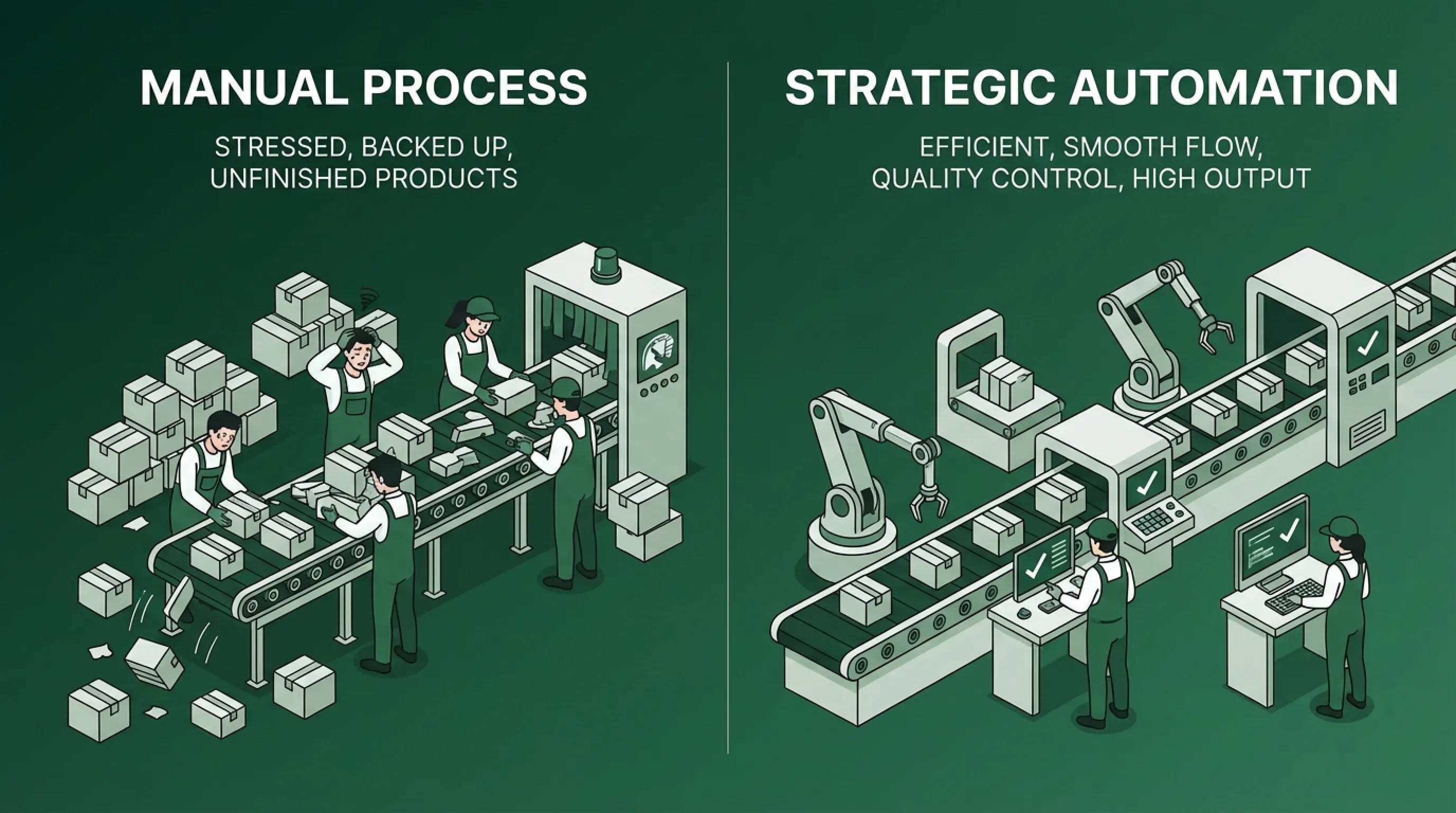
But manual processes don't scale linearly. They scale exponentially. Going from 50 to 100 members doesn't double your work, it triples it. Going from 100 to 500 multiplies it by ten. Eventually you hit a ceiling where manual operations consume all available time and growth stops.
Automation audits prevent this breakdown by identifying what to automate before it becomes a crisis. You systematically review every recurring task in your community. You categorize each task by whether it requires human judgment or if it's purely mechanical. You implement automation for mechanical tasks. You protect human time for tasks that need judgment.
The audit process has four steps. First, you document every task your team performs repeatedly. Welcome new members, assign roles, answer common questions, moderate content, manage tickets, update announcements, handle escalations. Write them all down.
Second, you categorize each task on two dimensions: repetitiveness and judgment requirement. High repetitiveness, low judgment requirement means automate fully. High judgment requirement means keep human involvement. Tasks in between might be partially automated.
Third, you identify automation solutions for high priority tasks. Automatic welcome thread creation when someone joins. Role assignment based on reactions or forms. Bot responses for FAQ questions. Auto moderation for content violations. Scheduled posting for announcements.
Fourth, you implement and monitor. Add the automation. Test it with real members. Measure if it reduces team workload without hurting member experience. Adjust as needed.
I worked with a creator community that was manually onboarding every new member. A team member would see the join notification, create a welcome thread, introduce themselves, walk through the server structure, answer questions, assign roles. It took 15 minutes per member.
At 100 members per month, that was 25 hours of team time. At 400 members per month, it would have been 100 hours. They couldn't scale that.
We automated thread creation and initial message. When someone joined, a bot instantly created a private thread with a structured welcome message explaining the community, linking to key resources, and prompting the member to introduce themselves. The bot tagged a team member to follow up.
Time per member dropped from 15 minutes to 3 minutes. The automation handled mechanical work, the human added personalization after the member responded. The team went from spending 25 hours monthly on onboarding to 8 hours, while actually improving the member experience because response time decreased.
We applied the same audit to FAQ responses. Analysis showed 40% of support questions were variants of 8 common topics. We created detailed documentation for each topic. We implemented a bot that detected keywords and automatically responded with relevant doc links. When the bot couldn't help, it created a support ticket for the team.
Support workload dropped 60%. Members got faster answers. The team focused on complex issues that actually needed human problem solving.
The automation audit also revealed tasks they thought needed human involvement but actually didn't. They were manually assigning beginner roles to everyone who introduced themselves. This took 30 seconds per person but added up to hours weekly. We automated it so anyone who posted in the introduction channel automatically received the role. Zero ongoing work, same outcome.
The principle is that automation should handle process and humans should handle judgment. When someone needs a welcome thread created, that's process. When they ask a nuanced question about their specific situation, that's judgment. Automate the process, preserve the human for judgment.
Some teams resist automation because they worry it makes the community feel robotic. This misunderstands where humans create value. Humans create value in personalized conversation, strategic guidance, and complex problem solving. They don't create value in mechanical tasks like thread creation or role assignment. Automating the mechanical frees humans to do more of what actually matters.
The technical implementation uses Discord bots. Some communities build custom bots. Most use existing solutions like Carl bot, YAGPDB, or Mee6 for basic automation. More complex workflows might use Zapier or Make to connect Discord with other tools.
The key is being systematic. Random automation based on whatever annoys you today creates a messy system. Methodical auditing based on task frequency and judgment requirement creates a scalable infrastructure.
You should audit quarterly as you grow. What works at 100 members might need adjustment at 500. New bottlenecks appear. New automation opportunities emerge. Regular audits ensure your operational infrastructure keeps pace with community growth.
Your competitors are scaling linearly by throwing more humans at growth. They're hiring more community managers to do the same manual tasks. Their costs scale with their members. Eventually they can't afford to grow.
You can scale exponentially by building automation infrastructure that handles mechanical work while your team focuses on strategic member relationships. Your costs stay flat while your community grows.
Manual work doesn't scale. Systems do. Audit before you burn out. Automate before you hit the ceiling. Build infrastructure that grows with you.
<<<<<<< HEAD