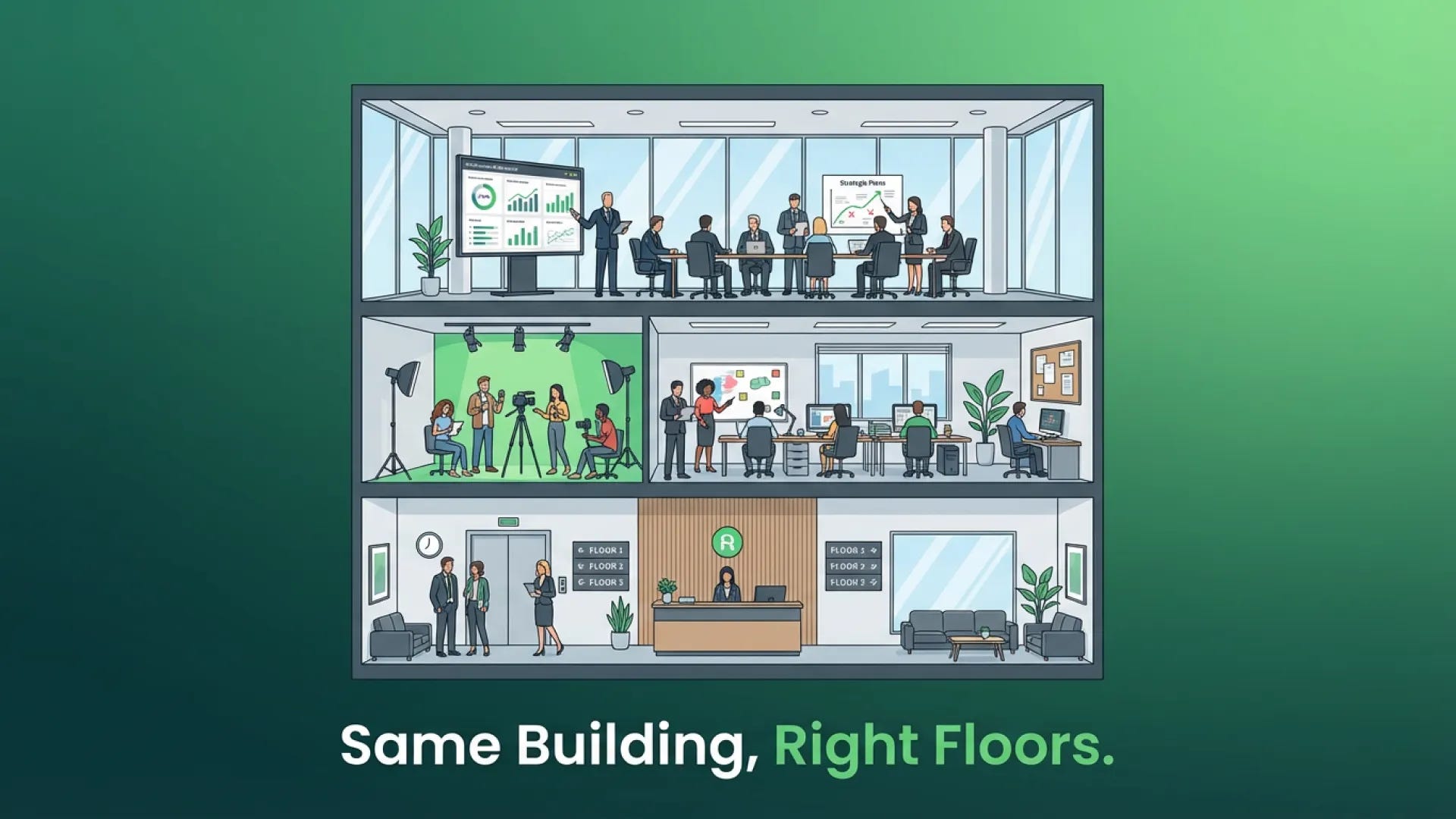
Every community manager eventually faces this question: should different audience types share the same spaces, or do they need separation?
The answer determines whether your community scales effectively or collapses under its own contradictions.
The context mismatch problem
When you're building a community that serves multiple stakeholder types, the natural instinct is inclusivity. Everyone should see everything. Total transparency. No artificial barriers.
This sounds good philosophically, but it fails practically.
Consider a TikTok shop agency community. Business owners join to evaluate the agency's systems, understand performance tracking, and coordinate on campaign strategy. Creators join to learn content production techniques, troubleshoot platform issues, and understand payment timelines.
These groups need fundamentally different information delivered in fundamentally different ways.
When a business owner logs in and sees dozens of messages about video editing techniques and hashtag strategies, they wonder if this community is sophisticated enough for their investment. When a creator sees discussions about six-figure monthly revenue targets and executive performance metrics, they feel out of place.
Neither perception reflects reality, but both are inevitable when audiences with different contexts occupy the same space.
The separation architecture
The solution isn't exclusivity for status reasons. It's separation for clarity reasons.
Business owners need channels focused on outcomes, data, and strategic coordination. Topics include performance metrics, timeline management, partnership expectations, and results analysis.
Creators need channels focused on execution, support, and peer learning. Topics include content production guidance, platform mechanics, payment processing, technical troubleshooting, and creative collaboration.
These aren't hierarchical divisions. They're contextual ones. A creator asking "when do payments process" is asking a completely legitimate question that needs a clear answer. But that question doesn't belong in a channel where business executives are reviewing quarterly performance data.
Similarly, a business owner asking about campaign ROI tracking needs detailed strategic discussion. That conversation doesn't need to be visible to every creator in the program who's just trying to figure out video upload specifications.
The information flow control
Separation doesn't mean total isolation. It means controlled information flow.
When the agency announces a new program feature, both audiences need to know. But they need different explanations. Business owners need to understand the strategic impact and how it affects their partnership. Creators need to understand the execution mechanics and how it changes their workflow.
One announcement, two channels, appropriate context for each audience.
This approach also naturally protects sensitive information. Business strategy discussions that involve pricing, margins, or competitive positioning don't need to be visible to every creator. Creator payout questions that involve individual payment issues don't need to clutter executive coordination channels.
The practical implementation
When agencies implement this separation, they typically see immediate improvements in both audience satisfaction and community efficiency.
Business owners report feeling like they're in a professional environment where their time is respected. They're not scrolling through dozens of execution-level questions to find strategic discussions. They're getting concentrated, relevant information.
Creators report feeling supported without intimidation. They can ask foundational questions without worrying about looking unsophisticated. They're learning from peers at similar experience levels without feeling like they're being evaluated by executives.
Your community team benefits too. Support questions route to appropriate channels. Strategic discussions stay focused. Everyone gets contextually appropriate information without compromise.
The common objection
The main pushback I hear is about creating artificial hierarchy or making some members feel excluded.
But this misunderstands the purpose. Separation isn't about making anyone feel less important. It's about making everyone more effective.
A creator doesn't need access to executive strategy channels to feel valued. They need responsive support, clear guidance, and peer community. A business owner doesn't need to see every creator support ticket to feel informed. They need performance data, strategic coordination, and professional communication.
Giving everyone access to everything doesn't create equality. It creates noise. Real respect means delivering the right information to the right people in the right context.
Build for both audiences properly
If your community serves multiple stakeholder types, stop compromising. Build spaces that actually serve each group's needs.
Separate the contexts. Control information flow. Let business conversations be strategic. Let creator conversations be practical. Everyone wins.
Serving everyone in the same space serves no one well.
<<<<<<< HEAD