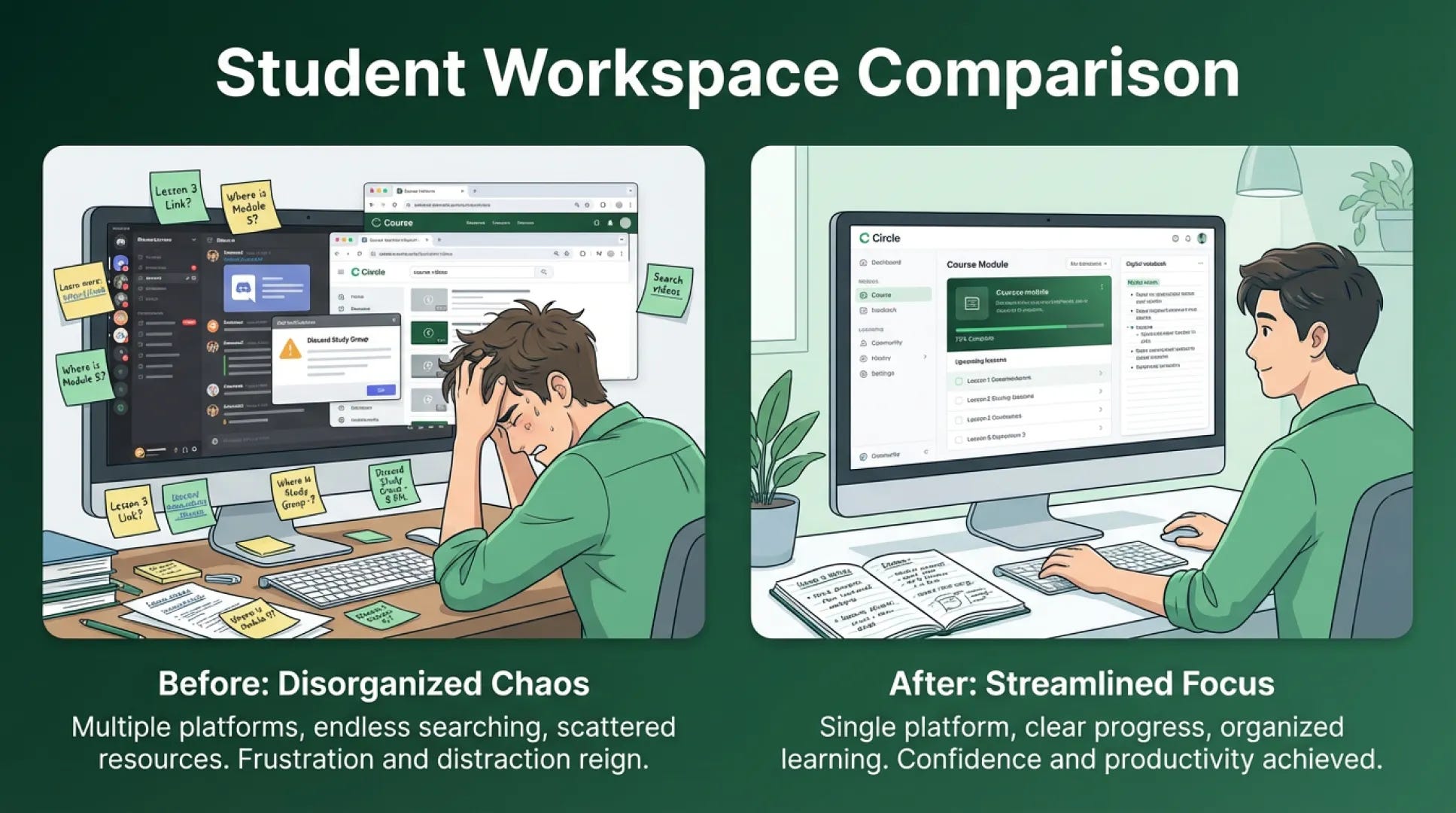
You're launching an educational program. Your offer includes weekly coaching, a Discord community, and a complete training course with 40 video lessons. You need somewhere to host the course content.
You decide to put everything in Discord. You create channels for each module. You post video links in each channel. You pin resources. You write instructions on how to navigate the course.
Your first students join. Within hours, the questions start. Where's lesson three? Did I miss module two? What order should I watch these? Am I supposed to be in this channel or that one? Can you link the previous lesson?
You answer the same navigation questions dozens of times. You realize you're spending more time explaining where content is than teaching the content itself. Discord isn't built for this.
This breakdown happens when founders try to use Discord for course delivery instead of discussion. Discord is a communication platform. It's built for conversation. It's excellent at that. It's terrible at structured sequential content delivery.
Course platforms like Circle, Teachable, or Kajabi are built specifically for learning. They provide features that educational content requires: video hosting integrated into the platform, progress tracking showing what students completed, sequential lesson flow guiding students from start to finish, completion markers indicating when modules are done, and course structure organizing content hierarchically.
These features aren't optional nice to haves. They're essential for learning experiences. Without them, students get lost, confused, and frustrated.
I consulted with a founder running a creator training program. She sold memberships for $3000. Members got access to a Discord community and a comprehensive course teaching content strategy. She hosted everything in Discord.
The course had 35 video lessons organized into seven modules. She created a Discord channel for each module. She posted YouTube links to each lesson. She wrote detailed instructions on how to navigate the course.
Student experience was chaos. New members would join, see dozens of channels, and have no idea where to start. They'd ask which channel to visit first. She'd explain the structure. They'd watch a few lessons, then forget which module they were on. They'd ask what to watch next. She'd tell them. This repeated constantly.
She tracked completion by periodically posting surveys asking who finished which modules. Less than 30% of students completed the full course. She assumed the content was the problem. She kept revising lessons. Completion stayed low.
The problem wasn't content quality. The problem was delivery infrastructure. Students weren't failing because the teaching was bad. They were failing because navigation was impossible.
We moved the course to Circle. Same 35 lessons, same seven modules, different platform. Circle organized content sequentially. Students could see their progress. They knew which lesson came next. They could mark lessons complete. The platform tracked everything automatically.
Student support questions about navigation dropped 70%. The founder stopped explaining where to find content because the platform made navigation obvious. Students focused on learning instead of hunting for lessons.
Completion rates jumped to 65%. Same content, same students, different infrastructure. The platform change removed friction that was preventing learning.
We kept Discord active for the community discussion component. Students discussed strategies, shared wins, asked implementation questions. Discord served its designed purpose: facilitating conversation. Circle served its designed purpose: delivering structured content.
The implementation principle is using the right tool for each job. Discord excels at real time discussion, community interaction, and spontaneous conversation. Course platforms excel at sequential content, progress tracking, and structured learning.
If your program includes both community and courses, use both tools. Host discussions where discussion tools exist. Host courses where learning tools exist. Don't try to force everything into one platform because integration seems simpler.
The integration concern is valid but overrated. Yes, students need to access two platforms. This creates mild friction. But that friction is nothing compared to the massive friction of trying to learn from scattered content in a discussion platform.
Students would rather visit two well designed platforms than struggle through one poorly suited platform. The navigation clarity of using purpose built tools far outweighs the inconvenience of logging into two places.
The practical setup links platforms clearly. Your Discord welcome message includes a link to course platform. Your course platform includes a link back to Discord. Students understand: go here for learning, go there for discussion.
Some founders resist separate platforms because they want everything centralized. This prioritizes founder convenience over student experience. You want simpler management. Students want effective learning. These goals conflict. Choose student experience.
The cost consideration matters. Circle requires a monthly subscription while Discord is free. But if you're charging students $1000+ for your program, the course platform cost is a rounding error compared to providing functional infrastructure.
Your competitors are trying to teach in Discord and wondering why completion rates are low. Their students are confused and frustrated. You can provide proper learning infrastructure and watch students actually complete what they started.
Use Discord for what it's built for. Use course platforms for what they're built for. Your students will thank you by actually finishing your course.
Learning requires structure. Discussion requires flexibility. Different goals need different tools. Use both.
<<<<<<< HEAD