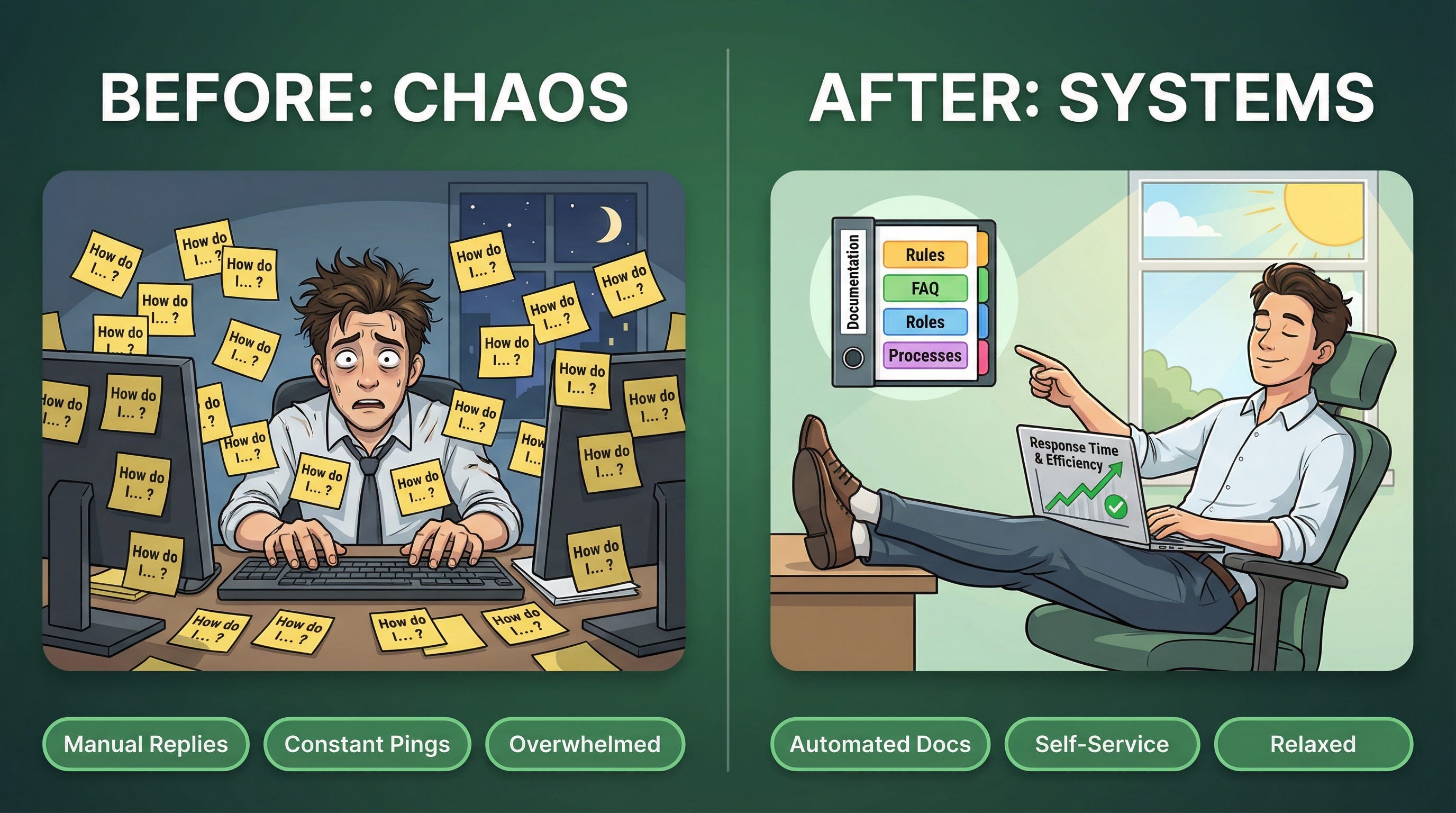
Your community manager just answered the same question for the 80th time this quarter.
How do I update my payment method. Where can I find the content calendar. What’s included in the premium tier. When do coaching calls happen.
She types out a detailed answer. Sends it. Feels helpful. Three hours later, someone else asks the exact same question. She types it again. This happens five times a day. Every day. For months.
This is what happens when you rely on real time responses instead of documentation.
The math is brutal. If answering a question takes three minutes and you answer it 80 times, that’s 240 minutes spent on one FAQ. Scale that across every repeated question and your team is losing entire workdays to redundant explanations.
Documentation eliminates this waste entirely. You write the answer once. You put it somewhere accessible. When someone asks, you link to the doc. Three minutes becomes 15 seconds. Do this for every common question and you save your team hundreds of hours per quarter.
The servers I manage that have comprehensive documentation spend 70% less time on repetitive support compared to servers that rely on in chat answers. That freed up time goes to actual community building, member engagement, strategic initiatives.
Documentation also improves member experience. When someone has a question at 2am, they don’t want to wait for your team to wake up. They want an answer now. If you have a searchable FAQ or pinned resources, they get instant resolution. If you don’t, they sit there frustrated or leave.
The content that belongs in documentation falls into several categories. Basic logistics: how to access things, where to find things, when things happen. Policies: refund terms, community rules, content guidelines. Processes: how to submit work, how to book calls, how to report issues. Troubleshooting: common technical problems and their solutions.
I worked with a creator community managing 400 members. Their support team was answering 200 questions per week. Analysis showed that 60% of those questions fell into 12 categories. We created documentation for all 12.
We built a dedicated FAQ channel with clear sections. Each common question got a detailed answer with screenshots where needed. We pinned a message at the top of every major channel linking to relevant FAQ sections. We trained the team to respond to repeat questions by linking the doc instead of retyping answers.
Support volume dropped 65% within three weeks. The team went from overwhelmed to available. Members got faster answers because they could search documentation instead of waiting for someone to respond.
The documentation also revealed gaps in their onboarding. Certain questions that should have been answered upfront were coming up repeatedly. They revised their welcome materials to cover those points, preventing the questions from ever being asked.
The technical implementation is flexible. Some communities use a dedicated FAQ channel in Discord with clear section headers. Others maintain a Notion page with searchable content and link to it from Discord. Some build custom knowledge bases. The platform matters less than the organization and accessibility.
The workflow is straightforward. Your team tracks questions that come up more than twice. Once something hits the repeat threshold, it goes into documentation. Someone writes a clear answer. Someone else reviews it for accuracy. It gets published and linked from relevant locations. When the answer changes, the doc gets updated.
You can enhance findability by tagging team members to reference specific docs, using Discord’s search function, creating a table of contents, or implementing a bot that surfaces relevant docs based on keywords.
Some teams resist documentation because writing feels like extra work. This misunderstands the tradeoff. Writing one answer takes 15 minutes. Typing that answer 80 times takes 240 minutes. The documentation pays for itself after the second reference.
Documentation also scales in ways that human responses can’t. Your team’s availability is limited. Documentation is available 24/7 across time zones. Your team can only answer so many questions simultaneously. Documentation can serve unlimited members at once.
The quality matters more than perfection. A decent doc that exists beats a perfect doc that you’ll write someday. Start with bullet points if that’s easier. Add detail over time. The goal is capturing the answer once so you don’t have to recreate it constantly.
Your competitors are burning out their teams with repetitive support. Their members are waiting hours for answers to questions that could be self served. You can win by implementing the basic documentation infrastructure that professional communities require.
Write it once. Reference it forever. Your team will thank you for every hour they don't spend retyping the same answer.
<<<<<<< HEAD